World Conference on Complex Systems – 2026

World Conference on Complex Systems 2026

Navigating Contemporary Complexity:

Transdisciplinary Approaches to Social, Political, and Environmental Disruption

World Conference on Complex Systems 2026

Navigating Contemporary Complexity:

Transdisciplinary Approaches to Social, Political, and Environmental Disruption

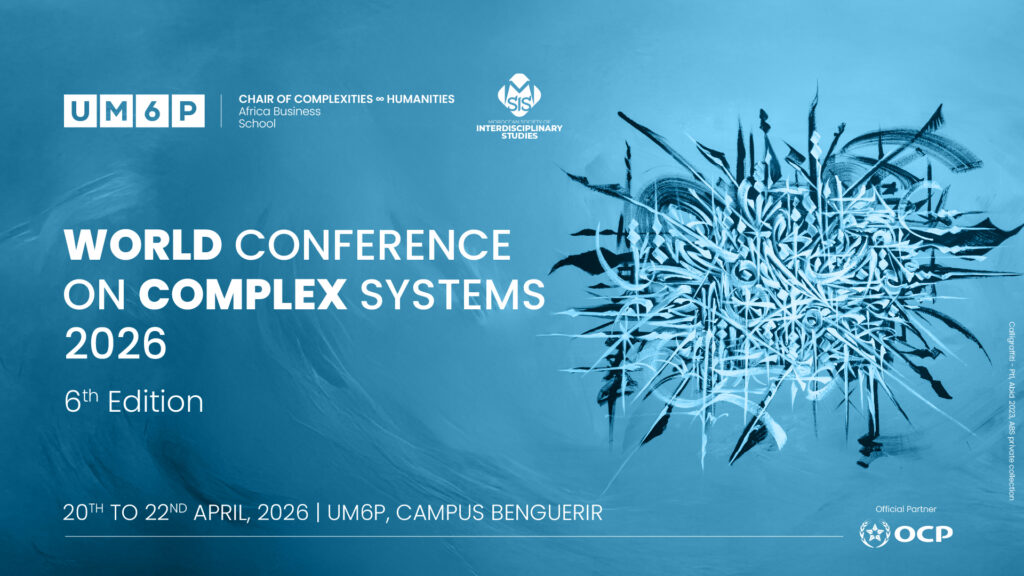
April, 20-22, 2026 – Mohammed VI Polytechnic University, Ben Guerir, Morocco

[ Conference Program (PDF)Talks (video recordings) ] 

The Chair of Complexities ∞ Humanities partnered with the Moroccan Society of Interdisciplinary Studies to host the 6th World Conference on Complex Systems (WCCS26) at UM6P in Benguerir, in April 2026.

Held under the theme Navigating Contemporary Complexity, the conference brought together leading researchers and Ph.D. students from across the world to present cutting-edge work, confront emerging challenges, and explore new frontiers in complex systems and interdisciplinary science. 

As a premier international platform, WCCS26 advanced collaboration and debate on the most sophisticated methods for understanding, modeling, simulating, predicting, and navigating societal, ecological, biological, and engineered complex systems. By convening experts across disciplines, it bridged theory and real-world application — driving scientific progress and innovation.

……………………………………………………… CC∞H ………………………………………………………

Video recordings

Relive the entire conference through the video recordings of the talks, panels, and parallel sessions. [click on name to view talk

Monday 20 April 2026

Keynote: Reda Benkirane. Lost in Complexity: Welcome to the Real World

Keynote: Peter Turchin. The Great Holocene Transformation: What Complexity Science Tells Us About The Evolution of Complex Societies

Panel 1 – Complexity, Society & Global Challenges

Carlos Álvarez Pereira. No Limits to Hope: Escaping from the unreasonable effectiveness of Modernity

David Chavalarias. The Artificialization of Cultural Evolution: the Impact of Very Large Digital Infrastructures on Individuals and Society

Louis Klein. Noospheric Singularity and the Mirror of Tamkeen

Panel 2 – Rethinking Knowledge in the Age of Complexity

Helena Knyazeva. Dancing with Complexity: How the World Thinks Through Us

Carlos Gershenson. The Implications of Complexity

Leonardo Rodríguez Zoya. Can Statistics Think? Complexity, Future, and Freedom in the Age of Large Language Models

Parallel Session 1

Track 1 – Agent-Based and Social Complexity

Track 2 – Foundations and Dynamics of Complex Systems

Tuesday 21 April 2026

Keynote: Abderrazak El Albani. Emergence of Intercellular Cooperation: At the Origins of Eukaryotic Complexity

Keynote:  Nigel Gilbert. Policy in a Complex World: Towards Complexity-Aware Policymaking

Parallel Session 2

Track 1 – Agent-Based and Social Complexity

Track 3 – Artificial Intelligence and Computational Systems

Keynote : Chris Bauch. Critical Transitions in Coupled Human-and-Natural Systems and their Early Warning Signals

Keynote: Abdelmajid Ibenrissoul. Public Decision-Making and Complexity: What Rationality for Evaluation?

Parallel Session 3

Track 4 – Socio-Ecological and Environmental Systems Session chair: Mohamed Bakhouya

Track 3 – Artificial Intelligence and Computational Systems

Wednesday, 22 April 2026

Keynote : Karoline Wiesner. The Physics of Political Change: Diffusion, Stability, and Regime Dynamics

Parallel Session 4

Track 1 – Agent-Based and Social Complexity

Track 2 – Foundations and Dynamics of Complex Systems

……………………………………………………… CC∞H ………………………………………………………

Monday 20 April 2026

Opening Keynote –Reda Benkirane. Lost in Complexity: Welcome to the Real World

 

Keynote –  Peter Turchin. The Great Holocene Transformation: What Complexity Science Tells Us About The Evolution of Complex Societies.


Panel 1 – Complexity, Society & Global Challenges


• Carlos Álvarez Pereira. No Limits to Hope: Escaping from the unreasonable effectiveness of Modernity

• David Chavalarias. The Artificialization of Cultural Evolution: the Impact of Very Large Digital Infrastructures on Individuals and Society

• Louis Klein. Noospheric Singularity and the Mirror of Tamkeen

Panel Chair: Karima Kadaoui  


Panel 2 – Rethinking Knowledge in the Age of Complexity

• Helena Knyazeva. Dancing with Complexity: How the World Thinks Through Us

• Carlos Gershenson. The Implications of Complexity

• Leonardo Rodríguez Zoya. Can Statistics Think? Complexity, Future, and Freedom in the Age of Large Language Models

Panel Chair: Nigel Gilbert  


Parallel Session 1

Track 1 – Agent-Based and Social Complexity

• Julian Arevalo. Adaptive Readiness: an Agent-Based Model of Peace Negotiations

• Remah Dahdoul. Campaign-Spending Driven Polarization Transition in a Double-Random Field Model of Elections

• Nicholas Roxburgh. Exploring Interdependencies in an Island Economy

• Saida Hachimi El Idrissi. Formation of Complex Societies: An Agent-Based Model Inspired by Freudian Theory  

Track 2 – Foundations and Dynamics of Complex Systems

• Giuseppe Orlando. Entropy-Based Recurrence Diagnostics for Tipping Points in Complex Dynamical Systems: Evidence from Cryptocurrency Markets

• Stanisław Drożdż. Complexity Characteristics of Natural Language: The Special Role of Punctuation

• Marcin Wątorek. Filtering Amplitude Dependence of Correlation Dynamics in Complex Systems

Tomoko Sakiyama. Multi-Perspective for Probability Coordination Brings SOC in Game of Life

……………………………………………………… CC∞H ………………………………………………………

Tuesday, 21 April 2026

Keynote Abderrazak El Albani. Emergence of Intercellular Cooperation: At the Origins of Eukaryotic Complexity


Keynote Nigel Gilbert. Policy in a Complex World: Towards Complexity-Aware Policymaking


Parallel Session 2

Track 1 – Agent-Based and Social Complexity

• Peter Jones. Presenting a Universal and Simple Conceptual Workbench to Situate and Encompass Complexity

• Nisrine Jarmoune. The Ontology of Behavior: Formalizing the Institutional Project as a Complex System

• Lionel Scotto d’Apollonia. Participatory Action Research with and for Society: The Case of “Oasis of Fraternity”

• Harvey Spencer Sánchez-Restrepo. Topological Patterns of Academic Success: Insights from Complex Network Analysis  

Track 3 – Artificial Intelligence and Computational Systems

• Wafae Mkhimri. Integrating Human-AI Collaboration for Automated Product Backlog Generation in Agile Development

• Hind Es-Sobbahi. Deep and Handcrafted Feature Descriptors for Iris Recognition: A Comparative Study

• Rahul Balamurugan. Emergent Consensus-Weighted Neural Network for Optic Disc-Cup Segmentation in Glaucoma

• Ayachi Ouafa. A ROS2-Based Indoor Mapping Dataset Acquired Using TurtleBot4  


Keynote Chris Bauch. Critical Transitions in Coupled Human-and-Natural Systems and their Early Warning Signals


Keynote Abdelmajid Ibenrissoul. Public Decision-Making and Complexity: What Rationality for Evaluation?


Parallel Session 3

Track 4 – Socio-Ecological and Environmental Systems Session chair: Mohamed Bakhouya

• Stephan Peter. Climate Change and Necessary Actions

• Luis Comolli. Emergence in Designed Agroecosystems: Collective Dynamics in a Perennial Multi-Species Agroforestry Network

• Masatoshi Funabashi. Socio-Ecological Evaluation of Synecoculture Implementation in Sub-Saharan Africa

• Shuntaro Aotake. Measuring Plant Biodiversity across Scales: The αβ Scale Diversity Model with Image-Based AI Estimation

Track 3 – Artificial Intelligence and Computational Systems

• Carlo Lucheroni. Electricity Market Time Series Forecasting by Machine Learning Methods

• Meryem Abtane. Optimization of Sensor Placement for Detecting Axle Bearing Faults in High-Speed Trains

• Salma Ariche. Embedded Mamdani Fuzzy Control of HVAC Systems in Battery Electric Vehicles

• Abderrahmane Boudribila. Automating PLC Code Generation from Textual Requirement Specifications  

……………………………………………………… CC∞H ………………………………………………………

Wednesday, 22 April 2026

Keynote Karoline Wiesner. The Physics of Political Change: Diffusion, Stability, and Regime Dynamics


Parallel Session 4

Track 1 – Agent-Based and Social Complexity

• Gerardus Bukkems. Mapping Regeneration through Viability Geometrics: Configurational Diagnosis beyond the Anthropocene

• Meriem Timouyas. Activity-Driven Spatial Agent-Based Modeling of Interaction Networks in Urban Systems: Application to epidemic dynamics in Agadir

• Marcela Lopes Alves. Neural Network-Based Parameter Estimation of a Labour Market Agent-Based Model

• Smahane Jebraoui. Agent-Based Approaches in Tourism Studies Insights, Applications, and Future Directions


Track 2 – Foundations and Dynamics of Complex Systems

• Mohamed Hibti. Propositions for Measuring the Complexity of Probabilistic Safety Assessment Models

• Ioana Andreea Jelea. Emergent Polycentricity in Synthetic Cities: From Agent-Centre Assignment to Evolutionary Urban Dynamics

• Jiří Nedomlel. Life Grows and Evolves by Adapting Its Exploration to the Environment

• Stefano Calzati. Being as Technics A Quantum-Informed Conjecture on Complexity

• Patrik Christen. Parallel Computation of Agent-Based Economic Models with Entity-Component-System Architecture


……………………………………………………… CC∞H ………………………………………………………
Overproduction of Elites and Social Instability. A conversation with Peter Turchin

Peter Turchin is a complexity scientist and one of the founders of Cliodynamics, the mathematical and data-driven study of long-term historical dynamics. Project Leader at the Complexity Science Hub Vienna, Research Associate at the University of Oxford, and Emeritus Professor at the University of Connecticut, he conducts research at the intersection of social and cultural evolution, historical sociology, mathematical modeling, and the construction of large historical databases. He is the driving force behind the Seshat Global History Databank, a large-scale collaborative project that systematically tests theories about the rise and fall of complex societies. His books include Ages of Discord (2016), Ultrasociety (2015), and End Times (2023), which examines elite overproduction and political disintegration, the subject of this conversation.

Peter Turchin
Interviewed by Nicolas Sperry-Guillou ​ ​
April 21, 2026, UM6P Benguerir

Content:
0:00 Introduction
1:15 From Biology to History: Peter Turchin’s Conversion
3:11 What is Cliodynamics?
4:32 Why Societies Collapse
8:20 Elite Overproduction: The Musical Chairs Analogy
10:00 Concrete Examples: United states.
13:17 The 2010 Prediction on American Instability
15:36 Trump as a Counter-Elite: Historical Parallels
18:32 Ibn Khaldun: A Precursor to Cliodynamics
23:33 A Universal Theory
25:32 The Wealth Pump and Possible Solutions
30:43 How Complex Societies Were Born: The Role of War
33:55 Peaceful Competition Between Nations

Audio, video, and editing by Multimedia Center – UM6P Business and Management Cluster & Samia Erraji ​ ​

Science Week 2026 – Connaissance tacite

Connaissance tacite

Des fondements scientifiques aux enjeux africains

Mardi 31 mars | 14h00 – 16h00


« Nous savons plus ce que nous pouvons dire », c’est ainsi que fut formulée pour la première fois en 1966 la notion de connaissance tacite par le médecin, chimiste, philosophe et économiste hongrois, Michael Polanyi.  Ordinairement, la connaissance, qui plus est, la connaissance scientifique, renvoie à ce que nous maîtrisons comme procédures et dont nous pouvons prévoir les résultats et l’application dans la vie réelle. Mais il est une autre connaissance, implicite et non moins active, qui se loge, entre autres, dans la tradition scientifique, notre éducation, nos croyances, nos représentations et nos opinions. Cette connaissance se déploie dans la plupart de nos actes producteurs de sens, en dehors de toute codification formelle, et s’appuie sur ce que nous observons, imitons et accomplissons. C’est ce que nous proposons d’explorer en contexte culturel marocain et africain.
 
Cette session a exploré la notion de connaissance tacite à travers un exposé introductif d’Emmanuel Malolo Dissakè, suivi d’une table ronde et d’une discussion ouverte avec le public.
 
Intervenants
  • Emmanuel Malolo Dissakè, professeur de philosophie à l’université de Douala, Cameroun, est auteur de plusieurs ouvrages, traducteur de Karl Popper et Paul Feyerabend. Il enseigne depuis 30 ans l’histoire et la philosophie des sciences et des techniques.
  • Housni Zbaghdi, directrice de la Maison de la Philosophie/Maroc qui anime des ateliers de philosophie sur le terrain (dans les écoles, les prisons, les orphelinats et les entreprises).
  • Fadoua Mhidia, est docteure en sciences sociales, diplômée de l’EGE et de l’Université Internationale de Rabat.
  • Reda Benkirane, professeur titulaire affilié, Chaire Complexités ∞ Humanités (ABS/UM6P), traitera de la connaissance tacite dans le cas de la génération Z.
Modérateur : Nicolas Sperry-Guillou, directeur du programme “Edge Dynamics”, Chaire Complexités ∞ Humanités.

Science Week 2026 – Altérités en/et devenir

Altérités en/et devenir

Divergence | Convergence | Émergence

Lundi 30 mars 2026 | 14h00 – 17h00


L’événement a réuni des « témoins » de l’altérité et des participants du programme Inspire de Cultur.Ed UM6P pour un temps de réflexion et de dialogue. À travers cette rencontre, nous avons exploré comment les différences et les interactions entre les cultures, les systèmes de savoirs et les expériences façonnent les sociétés contemporaines. En rassemblant des chercheurs, des intellectuels et des jeunes participants du programme Inspire, l’événement a créé un espace de dialogue mêlant réflexion académique, expression artistique et engagement intellectuel. Le programme a inclus des témoignages, des discussions, des expositions et des performances artistiques.

Quatre témoins et médiateurs culturels

  • Najat Vallaud-Belkacem, présidente de l’association France terre d’asile, ancienne ministre française de l’Éducation nationale, professeure affiliée à l’UM6P, a témoigné de « Je dans le regard de l’autre ».
  • Hassan Aslafy, socio-anthropologue franco-marocain, maître de conférences à l’Université de Toulouse, a abordé les « Andalousies » sous l’angle de « Je est un hôte ».
  • Fouad Laroui, écrivain, professeur à l’UM6P et directeur scientifique de la Semaine de la Science, a évoqué la situation dans laquelle « Je est un autre ».
  • Reda Benkirane, professeur affilié titulaire de la Chaire Complexités ∞ Humanités (ABS/UM6P), a traité du thème « Je entre identité et sentiment d’appartenance ».

 Chants 12 de Ghita Soumhi 

Teaser documentaire sur les cheikhates : Fatima Zahra Kodssi, Taha El Houmam et Ayoub Essayeb

Performance Slam: Yasmine Messaoudi et Ikram Sadrai

La session a été co-animée par Nicolas Sperry-Guillou (Chaire Complexités ∞ Humanités) ainsi que par Jihane Atlassi et Imane Belhami du groupe Inspire (Cultur.Ed).


Exposition photos des membres du groupe Inspire

Les altérités de Benguerir  –Ikram Sadrai, Amina Mamouni & Safaa Kotbi

Fragments of the Invisible – Ghita Soumhi

Naive Realism – Ayoub Essayeb & Ayman Stitou

Analytique avancée en milieu industriel: IA et autres familles d’algorithmes – Walid Daou

Analytique avancée en milieu industriel: IA et autres familles d’algorithmes ​

avec Walid Daou Directeur général de Cleverlytics, ancien directeur de l’UM6P School of Computer Sciences ​

Dans cette discussion sur l’analytique avancée en milieu industriel, Walid Daou dépasse le simple « hype » de l’IA pour présenter les principales familles d’algorithmes, allant du classique au machine learning et deep learning. Il illustre cela par des exemples concrets montrant comment ces méthodes améliorent les opérations industrielles, notamment la détection d’anomalies, la sécurité, la gestion de l’énergie et la planification. Il aborde également les principaux défis rencontrés sur le terrain, notamment la qualité des données, l’intégration et la clarification des problématiques.

Entretien mené par Reda Benkirane, le 20 novembre 2025 ​

Image et son: Imad Ouzrar

L’esprit pervers du capitalisme. Théologie et anthropologie libérale. Dany-Robert Dufour

Paris, 7 mai 2018. Entretien mené par Reda Benkirane

Dany-Robert Dufour est philosophe. Professeur émérite de l’université Paris 8, spécialiste des sciences de l’éducation il est l’auteur de Le Délire occidental et ses effets actuels dans la vie quotidienne : travail, loisir, amour (Les liens qui libèrent, 2014, Pocket 2018), Il était une fois le dernier homme (Denoël, 2012), L’individu qui vient… après le libéralisme (Denoël, 2011), La Cité perverse (Denoël, 2009, Folio, 2012), Le Divin marché (Denoël, 2007, Folio, 2012), On achève bien les hommes : de quelques conséquences actuelles et futures de la mort de Dieu (Denoël, 2005), L’Art de réduire les têtes : sur la nouvelle servitude de l’homme libéré à l’ère du capitalisme total (Denoël, 2003), Folie et démocratie (Gallimard, 1996), Les Mystères de la trinité (Gallimard, 1990), Le Bégaiement des maîtres : Lacan, Émile Benveniste, Lévi-Strauss (Rééd. Arcanes, 1988). Dany-Robert Dufour est également l’auteur d’une étude introductive sur Bernard Mandeville dont il a revu et commenté la nouvelle édition de sa Fable des abeilles (Pocket, 2017).

Rétrospective médiatique sur Abderrazak El Albani et les origines du vivant

Revue de différentes couvertures média autour des travaux de bio-géologie du Prof. Abderrazak El Albani, invité par la Chaire pour la session “Le Vivant: rétrospective et prospective” de la dernière Science Week de l’UM6P.


Explorer l’origine du vivant, Abderrazak El Albani

Entretien mené par Samia Erraji, 19/02/2025, UM6P Benguerir


لقاء مع عالم مغربي غيّر فهمنا لتاريخ الارض- من أزقة مراكش إلى أرقى مجلات العلم- عبد الرزاق الألباني

https://www.youtube.com/@NajibElMokhtari  


Enquête sur le patrimoine paléotonlogique, dossier préparé par Fatima El Ouafi, L’Economiste, 11/04/2025


J’ai tant de choses à vous dire…, 2M, 15/05/2025


ﻋﻠﻢ ﻭ ﺣﻀﺎﺭﺓ : عبد الرزاق الألباني Al Oula, 04/06/2025

Regards croisés sur la complexité dans les organisations

Conférence

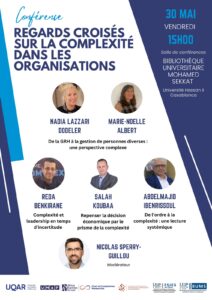
Le 30 mai dernier, la Chaire Complexités ∞ Humanités a co-organisé une conférence à la Bibliothèque Universitaire Mohammed Sekkat, en collaboration avec l’Université du Québec à Rimouski (UQAR) et l’Université Hassan II de Casablanca.

Intitulée “Regards croisés sur la complexité dans les organisations”, cette rencontre a réuni des intervenants de divers horizons pour explorer les multiples facettes de la complexité au sein des institutions et des dynamiques organisationnelles contemporaines.

  • De l’ordre à la complexité : une lecture systémique, Abdelmajid Ibenrissoul, Université Hassan II, Casablanca
  • De la GRH à la gestion de personnes diverses: une perspective complexe, Marie-Noelle Albert et Nadia Lazzari Dodeler, Université du Quebec à Rimouski
  • Repenser la décision économique par le  prisme de la complexité, Salah Koubaa, Université Hassan II, Casablanca
  • Complexité et leadership en temps d’incertitude, Reda Benkirane, Chaire Complexités ∞ Humanités, UM6P

Article dans L’Economiste, Jeudi 5 juin 202


Retrouvez l’intégralité de nos vidéos sur notre chaîne YouTube.