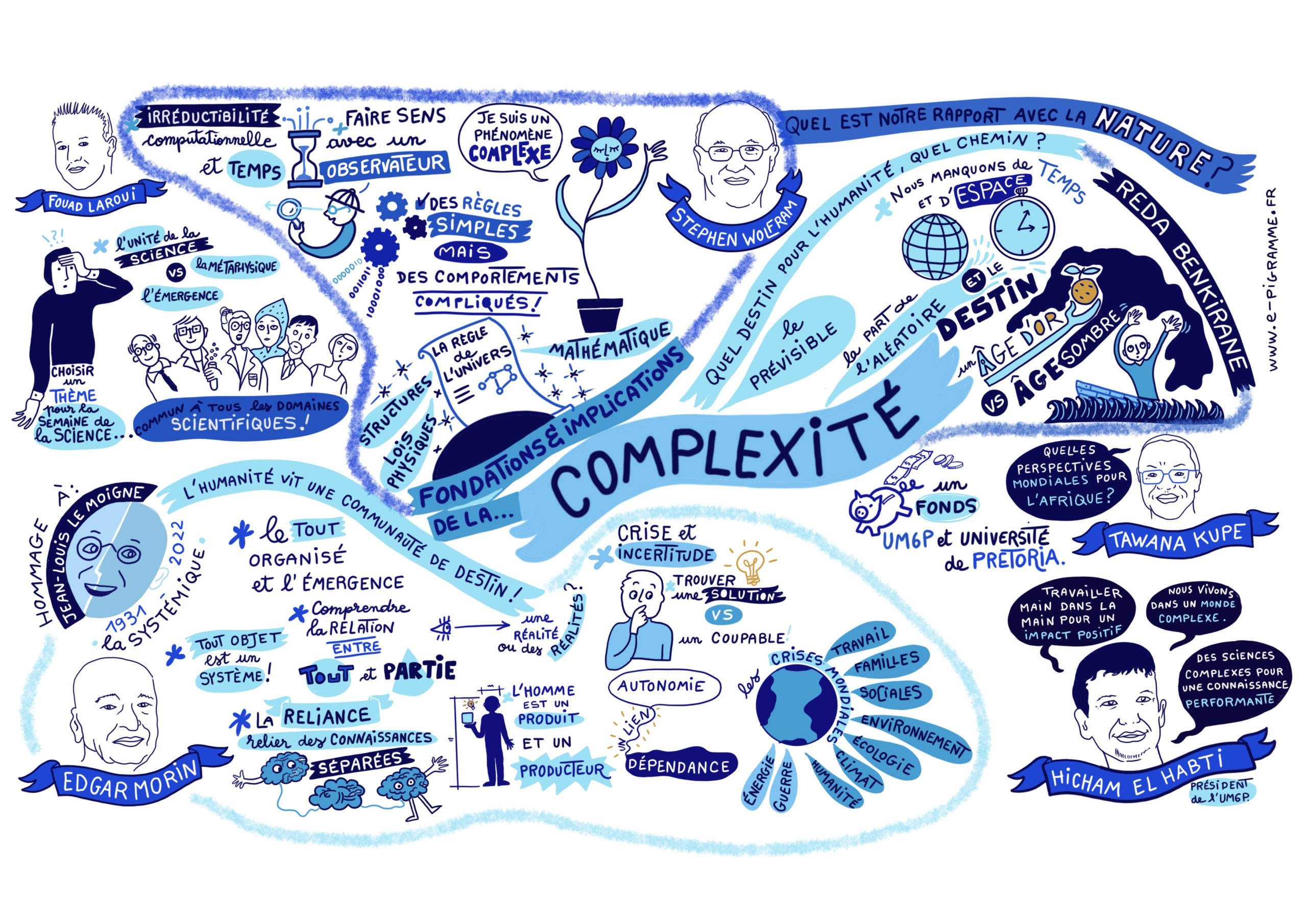
Ivar Ekeland, The Climate Change. Transition, Bifurcation or Catastrophe? 

UM6P, 22 February 2023, 46mn 

Introductory texts (English, French and Arabic) by Samia Erraji
Drawing by Sophie Lenormand

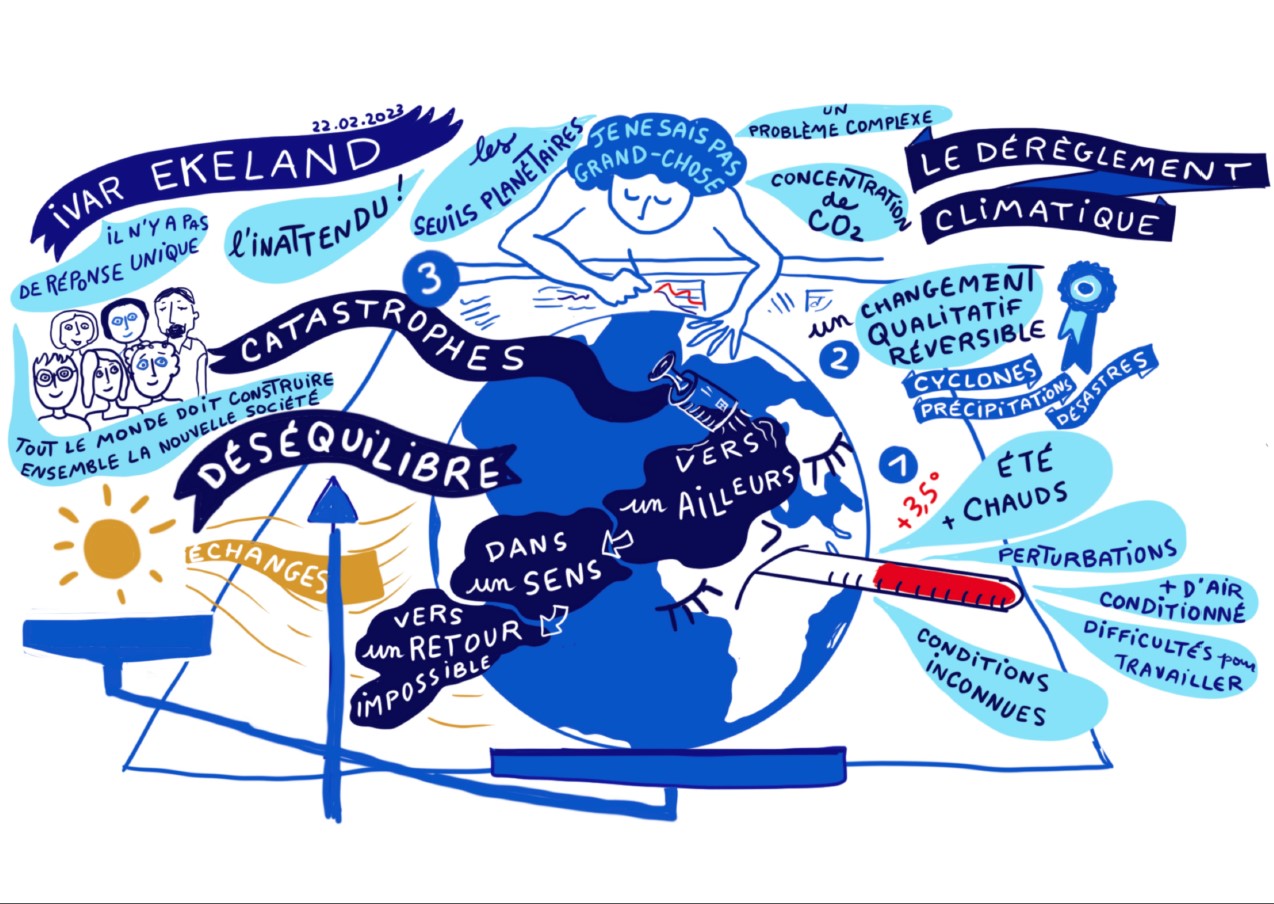
In this conference, Ivar Ekeland discusses climate change and the impact of human activities on the Earth’s temperature and carbon dioxide levels. He presents a graph showing temperatures and CO2 concentrations over 50,000 years. Ekeland identifies a significant and sudden increase in temperatures and CO2 emissions in the past 100 years, which he refers to as a “shock.”

Ekeland then poses a fundamental question: how does a complex system in equilibrium react to a small nudge or disturbance? He suggests four possible responses:

Firstly, Smooth Transition: some believe that the system will adjust smoothly to the changes, leading to gradual and manageable increases in temperatures and CO2 levels. They argue that humans can adapt to higher temperatures and even benefit from certain effects like increased CO2 for plant growth.

Secondly, Qualitative Change: Ekeland draws parallels with mathematical concepts like buckling and bifurcation, suggesting that a small nudge could cause a qualitative change or abrupt transition in the climate system. He points out various qualitative changes already observed in the climate, such as shifts in monsoons and precipitation patterns.

Thirdly, Catastrophic Change: Ekeland references catastrophe theory and warns that some changes in the climate system might be irreversible, leading to catastrophic consequences. He mentions planetary thresholds, where certain situations become extremely sensitive to small changes in parameters, like the disruption of the Atlantic deep-water formation.

The fourth answer is The Unexpected: Ekeland emphasizes the concept of not knowing what we don’t know, which can lead to unexpected outcomes. He highlights that managing climate change requires addressing complexity and uncertainty, as no single solution will be sufficient.

Ekeland urges that solutions to climate change must be complex, involving interdisciplinary collaboration and humility. He advocates for a new perspective in education and research, where individuals from various fields work together to tackle the complex challenge of climate change. Ekeland also emphasizes the importance of the precautionary principle, which suggests that in situations of uncertainty, actions should err on the side of caution and avoid potential harm.

Overall, Ekeland’s talk highlights the urgency and complexity of climate change and calls for a collective effort to address this global challenge.

Samia Erraji

Ivar Ekeland is a French mathematician, economist, and writer born in 1944. He has made significant contributions to mathematics, optimization theory, and mathematical economics. Ekeland has held prestigious academic positions and served as President of the University of Paris-Dauphine.

One of his most remarkableachievements is his work on catastrophe theory, where he highlighted the potential for abrupt and irreversible changes in complex systems, such as the climate.

Among his notable books is The Best of All Possible Worlds: Mathematics and Destiny (University of Chicago Press, 2006), where he explores the connection between mathematics and philosophy.

_________________________________

Lors de cette conférence, Ivar Ekeland aborde le changement climatique et l’impact des activités humaines sur les températures terrestres et les niveaux de dioxyde de carbone. Il présente un graphique montrant les températures et les concentrations de CO2 au cours de 50 000 années. Ekeland identifie une augmentation significative et soudaine des températures et des émissions de CO2 au cours des 100 dernières années, qu’il qualifie de “choc”.

Ekeland pose ensuite une question fondamentale : comment un système complexe en équilibre réagit-il à une petite perturbation ? Il propose quatre réponses possibles :

Premièrement, la Transition en douceur : Certains croient que le système s’adapte aux changements, entraînant des augmentations progressives et gérables des températures et des niveaux de CO2. Ils argumentent que les humains peuvent s’adapter à des températures plus élevées et même bénéficier de certains effets, comme l’augmentation du CO2 pour la croissance des plantes.

Deuxièmement, le changement qualitatif : Ekeland fait des parallèles avec des concepts mathématiques tels que le flambage et la bifurcation, suggérant qu’une petite perturbation pourrait provoquer un changement qualitatif ou une transition abrupte dans le système climatique. Il souligne différents changements qualitatifs déjà observés dans le climat, tels que les changements de moussons et de précipitations.

Troisièmement, le changement catastrophique : Ekeland fait référence à la théorie des catastrophes et met en garde contre le fait que certains changements dans le système climatique pourraient être irréversibles, entraînant des conséquences catastrophiques. Il mentionne les seuils planétaires, où certaines situations deviennent extrêmement sensibles aux petits changements de paramètres, comme la perturbation de la formation des eaux profondes de l’Atlantique.

La quatrième réponse est l’inattendu : Ekeland insiste sur le fait de ne pas savoir ce que nous ne savons pas, ce qui peut entraîner des résultats inattendus. Il souligne que la gestion du changement climatique nécessite de traiter la complexité et l’incertitude, car aucune solution unique ne suffira.
Ekeland insiste sur le fait que les solutions au changement climatique doivent être complexes, impliquant une collaboration interdisciplinaire et de l’humilité. Il plaide en faveur d’une nouvelle perspective en matière d’éducation et de recherche, où des individus de différents domaines travaillent ensemble pour relever le défi complexe du changement climatique. Ekeland souligne également l’importance du principe de précaution, qui suggère que dans les situations d’incertitude, les actions devraient faire preuve de plus de prudence et éviter les dommages potentiels.

S.E

Ivar Ekeland est un mathématicien, économiste et écrivain, né à Paris en 1944. Il a apporté des contributions significatives aux mathématiques, à la théorie de l’optimisation et à l’économie mathématique. Ekeland a occupé des postes académiques prestigieux et a été président de l’Université de Paris-Dauphine.

L’une de ses réalisations les plus remarquables est son travail sur la théorie des catastrophes, où il a souligné le potentiel de changements abrupts et irréversibles dans des systèmes complexes, tel que le climat.

Parmi ses livres notables, Le meilleur des mondes possibles : mathématiques et destinée (University of Chicago Press, 2006) explore le lien entre les mathématiques et la philosophie.

_________________________________

في هذا المؤتمر، يناقش إيفار إكلاند تغير المناخ وتأثير الأنشطة البشرية على درجات حرارة الأرض ومستويات ثاني أكسيد الكربون. يقدم رسمًا بيانيًا يوضح درجات الحرارة و تركيزات ثاني أكسيد الكربون على مدى الـ 50,000 سنة الماضية. يحدد إكلاند زيادة كبيرة ومفاجئة في درجات الحرارة وانبعاثات ثاني أكسيد الكربون في الـ 100 سنة الماضية، والتي يشير إليها بأنها “صدمة”.

ثم يطرح إكلاند سؤالاً أساسياً: كيف يتفاعل النظام المعقد مع الصدمات الصغيرة أو الاضطرابات؟ يقترح أربع إجابات محتملة:

أولاً، التحول السلس: يعتقد بعض الناس أن النظام يتكيف بسلاسة مع التغيرات، مما يؤدي إلى زيادات تدريجية وعقلانية في درجات الحرارة ومستويات ثاني أكسيد الكربون. فمن وجهة نظرهم، البشر يمكنهم التكيف مع ارتفاع درجات الحرارة وحتى الاستفادة من بعض التأثيرات مثل زيادة ثاني أكسيد الكربون على نمو النباتات.

ثانياً، التغيير النوعي: يقارن إكلاند بين مفاهيم رياضية مثل الالتواء والانشطار، مما يشير إلى أن الصدمة الصغيرة يمكن أن تتسبب في تغيير نوعي أو انتقال مفاجئ في نظام المناخ. ويشير إلى التغييرات النوعية المختلفة التي لوحظت بالفعل في المناخ، مثل الرياح الموسمية وأنماط الهطول.

ثالثاً، التغيير الكارثي: يشير إكلاند إلى نظرية الكوارث ويحذر من أن بعض التغييرات في نظام المناخ قد تكون لا رجعة فيها، مما يؤدي إلى عواقب كارثية. يذكر عتباتٍ كوكبية، حيث تصبح بعض الحالات حساسة للغاية للتغيرات الصغيرة في المعايير، مثل اضطراب تكوين المياه العميقة في المحيط الأطلسي.

الجواب الرابع هو غير المتوقع: يؤكد إكلاند على مفهوم عدم معرفة ما لا نعرفه، والذي قد يؤدي إلى نتائج غير متوقعة. يشدد على أن مواجهة تغير المناخ يتطلب معالجة التعقيد وعدم اليقين، حيث لن يكون حلاً واحدًا كافيًا.

يحث إكلاند على ضرورة أن تكون حلول تغير المناخ معقدة، تنطوي على تعاون مشترك بين التخصصات المختلفة والتواضع. يدعم فكرة وجود نظرة جديدة في التعليم والبحث، حيث يعمل الأفراد من مختلف المجالات معًا لمواجهة التحدي المعقد لتغير المناخ. يشدد إكلاند أيضًا على أهمية مبدأ الاحتراز، الذي يقترح أنه في حالات عدم اليقين، يجب أن تكون الإجراءات حذرة لتجنب الأضرار المحتملة.

سامية الراجي

إيفار إكلاند هو عالم رياضيات وكاتب وُلد في باريس سنة 1944. قدم مساهمات هامة في مجال الرياضيات ونظرية الأمثلية والاقتصاد الرياضي. شغل إكلاند مناصب أكاديمية مرموقة وكان رئيسًا لجامعة باريس-دوفين.

من أبرز إنجازاته عمله في نظرية الكوارث، حيث أبرز الإمكانية الحقيقية للتغييرات المفاجئة واللاعودة في الأنظمة المعقدة، مثل المناخ.

من بين كتبه البارزة أفضل عوالم ممكنة: الرياضيات والمصير (جامعة شيكاغو ،2006)، حيث يستكشف الصلة بين الرياضيات والفلسفة.
Stuart Kauffman, The Inevitable Anthropocene and our Choices Now: Prolegomenon to a Next Axial Age

UM6P, 22 February 2023, 58mn 

Introductory texts (English, French and Arabic) by Samia Erraji
Drawing by Sophie Lenormand

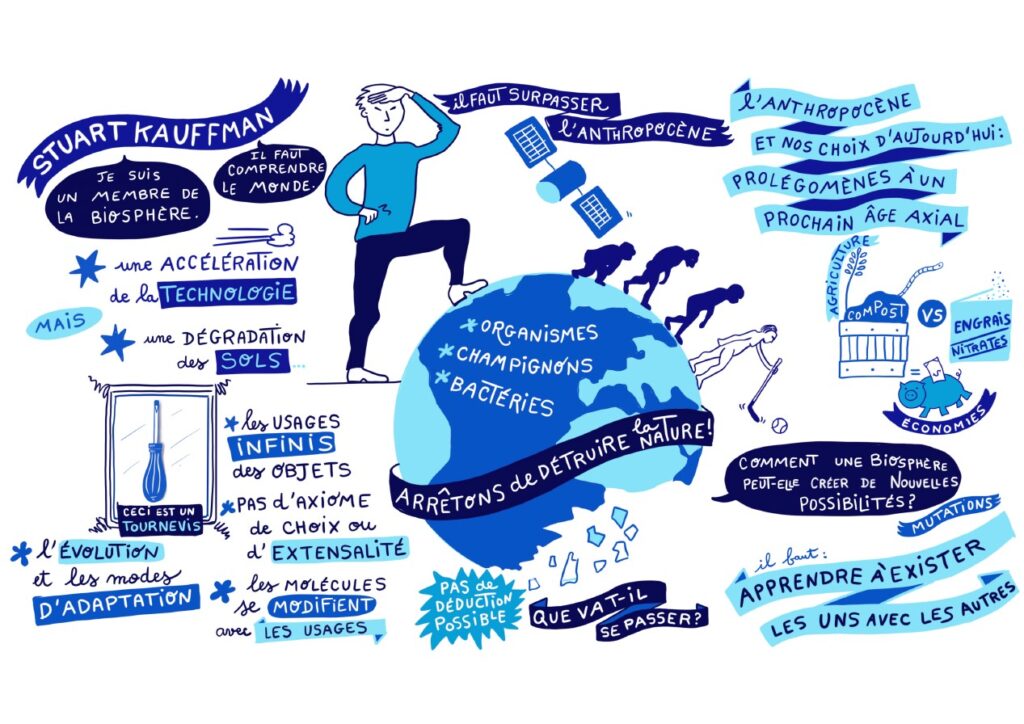
Stuart Kauffman’s presentation delves into the concept of co-evolution and its potential impact on the future. He emphasizes humanity’s connection to nature and contrasts it with historical Western science’s view of humans as separate entities. Kauffman introduces the idea of an “axial age” marked by transformative shifts in worldview and the emergence of religions and philosophies.  He continues by introducing a groundbreaking concept known as the “Theory of the Adjacent Possible” (TAP). This theory proposes that innovation and novelty emerge from the current state of a system, with the adjacent possibilities being the immediate next steps that can be explored from that state.

Stuart Kauffman connects the “TAP process” to the “Inevitable Anthropocene,” the human-driven era impacting the planet. He stresses the need for a spiritual transformation and a shift in practice to address environmental challenges.

Kauffman also discusses the work of biologist Joanna Xavier on molecular reproduction and introduces the concept of “Kantian holes” explaining how parts exist for and by means of the whole. He challenges set theory and traditional mathematics in predicting evolution due to the unique nature of emergent systems.

The American scientist discusses global soil regeneration experiments for sustainable agriculture and proposes a Global Creative Commons platform for sharing knowledge. He explores co-evolving bacterial communities and the potential of a distributed peer learning network.

In summary, Kauffman envisions a future where humanity collaborates with nature and fellow humans, embracing participatory science and cooperation to navigate challenges and build a sustainable world.

Samia Erraji

Stuart Kauffman, born in 1939, is an American theoretical biologist, complexity researcher, and author. Kauffman has made significant contributions to various fields, including biology, physics, and philosophy.

He earned his M.D. degree from the University of California, San Francisco, and later pursued a Ph.D. in biochemistry at the University of Oxford. Throughout his career, Kauffman held positions at prestigious institutions such as the Santa Fe Institute, where he was a founding member.

His interdisciplinary approach has led to groundbreaking insights into the nature of complexity and evolution. He has authored several books, including The Origins of Order (Oxford University Press, 1993) and At Home in the Universe (Oxford University Press, 1996).

_________________________________

Dans cette présentation, Stuart Kauffman aborde le concept de co-évolution et son impact potentiel sur l’avenir. Il souligne la connexion de l’humanité à la nature et la compare à la vision historique de la science occidentale qui considérait les humains comme des entités distinctes. Kauffman introduit l’idée d’une “ère axiale” marquée par des changements profonds dans la perception du monde et l’émergence de religions et de philosophies.

Kauffman relie cela au “processus TAP”, une équation qu’il a élaborée pour expliquer la croissance de la complexité et de la diversité des produits et du commerce. Il relie cela à “l’anthropocène inévitable”, où les changements induits par l’homme ont un impact sur les écosystèmes. 

Kauffman discute du travail de la biologiste Joanna Xavier sur la reproduction moléculaire et introduit le concept de “trous kantiens” expliquant comment les parties d’un être organisé existent pour et par le tout. Il remet en question la théorie des ensembles et les mathématiques traditionnelles pour prédire l’évolution en raison de la nature unique des systèmes émergents.

Stuart aborde les expériences de régénération mondiale des sols pour une agriculture durable et propose une plateforme “Communs créatifs mondiaux” de partage des connaissances. Il explore les communautés bactériennes en co-évolution et le potentiel d’un réseau mondial d’apprentissage entre pairs.

Le message principal de Kauffman appelle à  collaborer avec la nature plutôt que de chercher à la dominer. Il souligne le potentiel de la science participative, de la coopération mondiale et de l’apprentissage auprès de la biosphère pour créer un monde plus interconnecté et durable. Cette présentation suscite un changement de perspective, suggérant que comprendre et travailler avec la complexité inhérente de la biosphère peut conduire à des solutions innovantes dans divers domaines.

S.E

Stuart Kauffman, né en 1939, est un biologiste théoricien américain, chercheur en complexité et auteur.  Kauffman a apporté des contributions significatives dans divers domaines, notamment la biologie, la physique et la philosophie.

Il a obtenu son diplôme de docteur en médecine de l’Université de Californie, San Francisco, et a ensuite poursuivi un doctorat en biochimie à l’Université d’Oxford. Tout au long de sa carrière, Kauffman a occupé des postes dans des institutions prestigieuses, telles que l’Institut de Santa Fe, dont il était membre fondateur.

Son approche interdisciplinaire a conduit à des idées révolutionnaires sur la nature de la complexité et de l’évolution. Il est l’auteur de plusieurs livres, dont The Origins of Order (Oxford University Press, 1993) et At Home in the Universe (Oxford University Press, 1996).

_________________________________

يدور عرض ستيوارت كوفمان حول التحول العميق الحالي في عصرنا، والذي يصفه بمصطلح “المؤشر”، متسائلاً عن الفصل التاريخي بين الإنسانية والطبيعة. يستكشف مفهوم “العصر المحوري”، فترة التحولات العميقة في الرؤية العالمية والقيم. يربط كوفمان هذا بمعادلة وضعها لشرح نمو التعقيد وتنوع المنتجات والتجارة.

يربط ذلك بـ “حقبة التأثير البشري “، حيث تؤثر التغييرات التي يقوم بها الإنسان على النظم البيئية. يقترح كوفمان تحولًا روحيًا وتغييرًا في الممارسات لمواجهة تحديات هذا العصر. يقدم مفهوم “الثقوب الكانطية” كشرحً لكيفية وجود أجزاء كيان منظم، متحديا الرياضيات التقليدية ومؤكدا على عجزها عن التنبؤ بسلوك الأنظمة.

ينتقل كوفمان إلى اكتشاف ثوري مع أندريا رولي يعطل تطبيق الرياضيات التقليدية لفهم التطور بسبب طبيعة الاستكشافات والتكيفات الفريدة.

يقترح كوفمان بالتعاون مع يان ديكسترهاوس وجون كراوفورد، تجديد التربة كحل ناجع لتجاوز المشاكل الزراعية والإمكانات المحتملة للبذور المعالجة، بهدف إظهار فعاليتها دون الحاجة للأسمدة التقليدية. كما يقترح الاستعانة بمنصة “Creative Commons” لمشاركة المعرفة الزراعية على نطاق عالمي ويؤكد على دراسة المجتمعات البكتيرية لفتح آفاق جديدة.

ينادي كوفمان بالتعايش مع الطبيعة والمشاركة في عملياتها كما يدعو إلى تحول روحي وعملي لمواجهة تحديات حقبة التأثير البشري، مشجعًا على التعاون ومشاركة المعرفة لبناء مستقبل مستدام.

سامية الراجي

ستيوارت كوفمان هو عالِم بيولوجي نظري أمريكي، وباحث في مجال التعقيد، وكاتب. وُلد في 28 سبتمبر 1939 في بنسلفانيا. قدم كوفمان مساهمات كبيرة في مجموعة من المجالات، بما في ذلك علم الأحياء، والفيزياء، والفلسفة.

حصل على درجة الدكتوراه في الطب من جامعة كاليفورنيا، سان فرانسيسكو، وتابع بعد ذلك دراساته في البيوكيمياء في جامعة أكسفورد. طوال مسيرته المهنية، شغل كوفمان مناصب في مؤسسات مرموقة مثل معهد” سانتا في”، حيث كان عضوًا مؤسسًا.

نهجه المتعدد التخصصات أدى إلى رؤى ثورية حول طبيعة التعقيد والتطور. لقد كتب العديد من الكتب،  (At Home in the Universe (Oxford University Press, 1996) ،The Origins of Order (Oxford University Press     

Stephen Wolfram, Foundations and Implications of Complexity

UM6P Science Week, 54mn 

Introductory texts (English, French and Arabic) by Samia Erraji
Drawing by Sophie Lenormand

In a thought-provoking presentation, Stephen Wolfram delves into the concept of universal computation and its profound implications in both technology and science. The great physicist introduces the principle of computational equivalence, which posits that computational sophistication is a ubiquitous phenomenon in natural systems, above a certain threshold. This revelation leads to the phenomenon of computational irreducibility, where certain processes in nature cannot be simplified or predicted in a systematic way.

Stephen Wolfram explores the idea that computational irreducibility imposes limitations on what can be achieved in traditional scientific approaches, particularly in the realm of prediction and understanding complex systems. He explores how computational irreducibility challenges the very foundation of classical scientific paradigms, which rely on deterministic equations and precise mathematical models to describe the behavior of natural phenomena.

However, the talk takes a turn towards a new perspective in science, introducing the multi-computational paradigm. In this paradigm, the role of observers becomes crucial, as different observers can take slices of the computational space and observe certain aspects of the system that exhibit computational reducibility. This multi-computational approach opens new avenues for scientific progress, allowing for the discovery of patterns and regularities in complex systems that were previously obscured by computational irreducibility.

Stephen Wolfram emphasizes that while computational irreducibility poses inherent limitations on what can be known and predicted in science, it also underscores the significance of the passage of time and the dynamic nature of the universe. The unpredictability of certain systems highlights the importance of embracing the concept of time as a fundamental component in scientific exploration.

Furthermore, the presentation touches upon the potential applications of the principles discovered in physics in other fields, such as economics. While the fundamental laws of physics may hold true in various contexts, the nature of observers and the specific computational slices they observe can significantly impact the conclusions drawn in different domains.

Samia Erraji

Stephen Wolfram is a British-American scientist, computer scientist, and entrepreneur born in 1959. He is best known for his contributions to theoretical computer science and for creating the symbolic computation software Mathematica. In 1987, he founded Wolfram Research, where he developed the Wolfram Alpha search engine. Wolfram is the author of, most notably, A New Kind of Science (Wolfram Media, 2002), which explores complex systems based on simple rules. His work has had a significant impact on various fields, including physics, mathematics, artificial intelligence, and bioinformatics.

_________________________________

Dans un captivant exposé, Stephen Wolfram explore le concept de la computation universelle et ses implications profondes tant dans la technologie que dans les sciences. Le physicien présente le principe de l’équivalence computationnelle, qui suggère que le développement computationnel exceptionnel est un phénomène courant dans les systèmes naturels, au-dessus d’un certain seuil.

Cela conduit à la notion d’irréductibilité computationnelle, où certaines opérations dans la nature ne peuvent pas être simplifiées ou prédites de manière systématique. Cela impose des limites fondamentales à ce que l’on peut réaliser dans l’approche scientifique traditionnelle, en particulier en matière de prédiction et de compréhension des systèmes complexes.

Cependant, le discours prend un cours inédit en s’inscrivant dans une nouvelle perspective dans les sciences, en présentant le concept de la multicomputation. Dans cette approche, le rôle des observateurs devient crucial, car différents observateurs peuvent prendre des tranches du domaine computationnel et observer certaines facettes du système qui révèlent l’irréductibilité computationnelle. Cela ouvre de nouvelles possibilités pour les progrès scientifiques, permettant la découverte de modèles et de régularités dans les systèmes complexes qui étaient auparavant cachés en raison de l’irréductibilité computationnelle.

Stephen Wolfram souligne que bien que l’irréductibilité computationnelle impose des limitations sur ce que nous pouvons connaître et prédire dans les sciences, elle met également en évidence l’importance du passage du temps et la nature dynamique de l’univers. L’incertitude de certains systèmes révèle l’importance d’intégrer le concept de temps comme une partie essentielle de l’exploration scientifique.

En outre, la présentation de Stephen Wolfram aborde les applications potentielles des principes découverts en physique dans d’autres domaines, tels que l’économie. Alors que les lois fondamentales de la physique peuvent être valides dans différents contextes, la nature des observateurs et de leurs tranches computationnelles peuvent grandement influencer les conclusions tirées dans différents domaines.

S.E

Stephen Wolfram est un scientifique, informaticien et entrepreneur anglo-américain né en 1959. Il est surtout connu pour ses contributions à l’informatique théorique et pour avoir créé le logiciel de calcul symbolique Mathematica. En 1987, il fonde Wolfram Research, où il développe le moteur de recherche Wolfram Alpha. Wolfram est notamment l’auteur du livre A New Kind of Science (Wolfram Media, 2002), qui explore les systèmes complexes basés sur des règles simples. Son travail a eu un impact significatif sur plusieurs domaines, y compris la physique, les mathématiques, l’intelligence artificielle et la bio-informatique.

_________________________________

في محاضرة مثيرة للاهتمام، انغمس ستيفان وولفرام في مفهوم الحوسبة الشاملة وتأثيراتها العميقة على التكنولوجيا والعلوم. مقدما مبدأ المعادلة الحسابية، الذي يقترح أن التطور الحسابي الاستثنائي هو ظاهرة شائعة في الأنظمة الطبيعية، إلى أن فعاليته تظل محدودة. يؤدي هذا الاكتشاف إلى ظاهرة الاختزال الحسابي، حيث لا يمكن تبسيط أو توقع بعض العمليات في الطبيعة بطريقة منهجية.

يستكشف العالم الفيزيائي فكرة أن الاختزال الحسابي يفرض قيودًا جوهرية على ما يمكن تحقيقه في المنهج العلمي التقليدي، خاصة في مجال التنبؤ وفهم الأنظمة المعقدة. كما يناقش ستيفان وولفرام كيف أن الاختزال الحسابي يتحدى أسس المفاهيم العلمية التقليدية، التي تعتمد على المعادلات المحددة والنماذج الرياضية الدقيقة لوصف سلوك الظواهر الطبيعية.

يأخذ حديث ستيفان وولفرام منعطفًا آخر نحو وجهة نظر جديدة في العلوم، حيث يقدم مفهوم الحوسبة المتعددة. في هذا المفهوم، يصبح دور المراقبين حاسمًا، حيث يمكن لمختلف المراقبين أن يأخذوا شرائح من المجال الحسابي و يلاحظون بعض جوانب النظام التي تظهر الاختزال الحسابي. يفتح هذا النهج المتعدد إمكانيات جديدة للتقدم العلمي، مما يسمح باكتشاف أنماط جديدة في الأنظمة المعقدة التي كانت محجوبة سابقًا بسبب الاختزال الحسابي.

يؤكد ستيفان وولفرام أنه على الرغم من أن الاختزال الحسابي يفرض قيودًا أساسية على ما يمكن معرفته وتوقعه في العلوم، إلا أنه يؤكد أيضًا أهمية عنصر الزمن وطبيعة ديناميكية الكون.

إضافة إلى ذلك، تلامس المحاضرة تطبيقات محتملة للمبادئ التي اكتشفت في الفيزياء في مجالات أخرى، مثل الاقتصاد وغيرها. إذ تظل القوانين الأساسية للفيزياء صحيحة في سياقات مختلفة، كما أن طبيعة المراقبين والشرائح الحسابية الخاصة بهم يمكن أن تؤثر بشكل كبير على الاستنتاجات المستخلصة في المجالات المختلفة.

سامية الراجي

ستيفن وولفرام هو عالم ومبرمج ورائد أعمال بريطاني-أمريكي، ولد سنة 1959 في لندن. اشتهر بمساهمته في علم الحوسبة النظرية بإنشاء برنامج الحسابات الرمزية “ماتيماتيكا”. في عام 1987، أسس شركة “وولفرام للأبحاث” حيث طور محرك البحث “وولفرام ألفا”. كما ألف وولفرام كتاب بعنوان نوع جديد من العلوم (وولفرام ميديا ،2002) واستكشف فيه الأنظمة المعقدة المبنية على قواعد بسيطة. عمله أثر بشكل كبير في عدة مجالات منها الفيزياء والرياضيات والذكاء الصناعي وعلم المعلومات الحيوية.

Edgar Morin, Le défi des complexités en temps de crise

UM6P Science Week, 20 février 2023, 24mn
The Challenges of Complexities in Times of Crisis

Textes introductifs (français, anglais et arabe) de Samia Erraji

Dans son discours d’ouverture, Edgar Morin rend tout d’abord hommage à Jean-Louis Lemoigne, son ami et maître de la systémique, et poursuit ensuite en expliquant que tout objet est un système complexe d’éléments interconnectés. Il souligne l’importance de comprendre les relations entre le tout et ses parties pour appréhender un système. Le penseur aborde les crises mondiales, telles que la menace nucléaire, la crise de la mondialisation, l’écologie et la pandémie, qui sont interconnectées et s’entretiennent mutuellement. Il insiste sur la nécessité d’une prise de conscience collective et d’une solidarité humaine pour trouver des solutions globales aux problèmes actuels. L’implication individuelle et collective est encouragée pour préserver la biosphère et éviter des conflits mondiaux destructeurs. Edgar Morin appelle à une nouvelle forme de mondialisation basée sur la collaboration et la responsabilité. Il souligne que l’humanité est confrontée à une communauté de destin et doit agir de manière proactive pour relever les défis actuels.

Samia Erraji

Edgar Morin est un intellectuel français né en 1921 à Paris. Philosophe, sociologue et anthropologue, il est connu pour son approche de la pensée complexe et de sa Méthode multidisciplinaire qui traite de problèmes fondamentaux et globaux. Au cours de sa carrière, il a publié de nombreux ouvrages influents sur des sujets tels que la sociologie, la politique, l’éducation, la culture et la communication. Edgar Morin est une figure intellectuelle éminente dont l’impact transcende les frontières géographiques et linguistiques, laissant un héritage durable, Son héritage est célébré par l’existence d’une université au Mexique ainsi que de nombreux instituts portant son nom. Edgar Morin a reçu de multiples distinctions, dont des prix prestigieux. De plus, plusieurs universités de renom lui ont décerné le titre de docteur honoris causa, soulignant ainsi l’importance de son travail dans le domaine des sciences humaines.

_________________________________

In his opening speech, Edgar Morin pays tribute to Jean-Louis Lemoigne, his dear friend, and a prominent figure in systems theory, and continues by explaining that every object is a complex system of interconnected elements. He emphasizes the importance of understanding the relationships between the whole and its parts to comprehend a system fully. The thinker addresses global crises, such as the nuclear threat, globalization crisis, ecological issues, and the pandemic, pointing out their interconnected nature and mutual reinforcement. He stresses the need for collective awareness and human solidarity to find global solutions to current problems. Individual and collective involvement is encouraged to preserve the biosphere and avoid destructive global conflicts. Edgar Morin calls for a new form of globalization based on cooperation and responsibility. He highlights that humanity shares a common destiny and must proactively address current challenges. 

SE

Edgar Morin is a French intellectual born in 1921 in Paris. He is a philosopher, sociologist, and anthropologist, known for his approach to complex thinking and his multidisciplinary Method, which addresses fundamental and global issues. Throughout his career, he has published numerous influential works on subjects such as sociology, politics, education, culture, and communication.

Edgar Morin is an eminent intellectual figure whose impact transcends geographical and linguistic boundaries. His legacy is celebrated by the existence of a university in Mexico, as well as numerous other institutes, bearing his name. He has received multiple distinctions, including prestigious awards. Moreover, several renowned universities have awarded him the title of honorary doctor, highlighting the significance of his contributions to the field of humanities.

_________________________________

استهل إدغار موران خطابه بإحياء ذكرى الراحل جون لويس لوموان، صديقه وأحد الشخصيات البارزة في مجال الأنظمة، ثم تابع متحدثا عن موضوع الأزمات مسلطا الضوء على تعقيد الأنظمة. إذ أكد في خطابه على حقيقة أن كل عنصر في الحقيقة هو نظام من العناصر المترابطة، وأن خصائص الكل يمكن أن تفوق تلك الأجزاء الفردية. كما ذكر المفكر العديد من الأزمات العالمية مثل التهديدات النووية، الأزمات البيئية، الجائحة والحروب العالمية التي عاصرها شخصيا، مشددًا على أهمية أن يدرك الناس هذه المشكلات وأن يسعوا لإيجاد حلول عالمية تقوم على التضامن الإنساني والحفاظ على البيئة.

سامية الراجي

إدغار موران هو مفكر فرنسي وُلد سنة 1921 في باريس. فيلسوف عالم اجتماع وإنثروبولوجيا، وهو معروف بنهجه التفكير المعقد وطريقته الفريدة في معالجة المشاكل العالمية. على مدى مسيرته المهنية، نشر إدغار موران العديد من الأعمال المؤثرة حول مواضيع مثل علم الاجتماع والسياسة والتعليم والثقافة والاتصال.

إدغار موران هو شخصية فكرية بارزة تجاوز تأثيرها الحدود الجغرافية واللغوية، تاركا خلفه إرثا مهما.  إذ تحمل العديد من المعاهد اسمه، أبرزها جامعة إدغار موران بالمكسيك. وقد حصل على العديد من الجوائز الرفيعة ولقب الدكتور الفخري، مما يؤكد أهمية عمله في مجال العلوم الإنسانية.

Luc Steels, Promises and Limitations of Contemporary AI

UM6P Science Week, 21 February 2023, 52mn

Introductory texts (English, French and Arabic) by Hind Aboulazm 
Drawing by Sophie Lenormand

Luc Steels is a linguist by training and one of the main thinkers on artificial intelligence and robotics. He offers  alternative paradigms to artificial intelligence, addressing issues about body model, language, origins of language, origins of symbols, evolution, cooperation, and about how a mind could grow in artificial agents.

AI systems are being utilized to tackle complex problems through (deep) reinforcement learning. However, their limitations are becoming evident, particularly in areas like perception, where sensitivity to specific features can make them fragile. For instance, AI systems struggle to generalize when faced with different lighting conditions in image recognition tasks.

Recently, the big talk about conversational interfaces has gained significant attention, with systems like Google Lambda and OpenAI’s GPT, valued at billions of dollars. However, there are concerns about the accuracy and trustworthiness of the generated content. Misinformation and errors in texts produced by conversational AI pose risks to the information ecosystem.

Another issue lies in the use of AI to generate new content, such as images and code. Copyright and accuracy problems arise when AI utilizes existing works to create new ones. The inherent flaws in AI technology make it challenging to ensure the correctness and reliability of generated content.

Luc Steels advocates for combining a knowledge-based approach with data-driven AI to address the complexity of real-world problems. He emphasizes the importance of considering fundamental problems before releasing AI technologies.

In his work, Steels draws from the perspective of complexity, tracing its roots in AI research since the 1950s. He explores the idea of “scala naturae” which focuses on intentional stances and how entities possess self-recognition, subjective experience, and awareness.

Steels conducts numerous experiments to understand how complexity emerges in artificial systems. By studying the interactions between multiple autonomous robots and their emergent behaviors, he gains insights into cognition and mental capabilities. This complex systems approach helps shed light on open problems in neuroscience, such as the origins of color categories and self-awareness in robots.

In conclusion, Luc Steels is a pioneering linguist and AI researcher who seeks alternative paradigms for artificial intelligence.His work emphasizes the need to address fundamental problems and complexities in AI technologies to ensure their responsible and effective use in real-world applications.

Hind Aboulazm


_________________________________

Luc Steels est un linguiste et l’un des principaux penseurs en intelligence artificielle et en robotique. Son travail se concentre sur le développement de paradigmes alternatifs pour l’intelligence artificielle, abordant des questions telles que le modèle corporel, le langage, les origines du langage, les symboles, l’évolution, la coopération et le développement de l’esprit chez les agents artificiels.

Il souligne les limites de l’intelligence artificielle actuelle, notamment dans le domaine de la perception et de la fragilité des systèmes face à la généralisation des caractéristiques. Les interfaces conversationnelles suscitent également des inquiétudes concernant la fiabilité et l’exactitude du contenu généré.

Steels préconise une approche combinant l’intelligence artificielle basée sur la connaissance et celle axée sur les données pour relever les défis complexes du monde réel. Il s’appuie sur la perspective de la complexité, explorant les positions intentionnelles et la conscience chez les entités.

Ses expériences sur les systèmes complexes et les comportements émergents des robots autonomes enrichissent notre compréhension de la cognition et des capacités mentales. Elles ouvrent de nouvelles perspectives en neurosciences, notamment sur les origines des catégories de couleurs et la conscience de soi chez les robots.

En résumé, Luc Steels est un pionnier en linguistique et intelligence artificielle, dont les recherches contribuent à repenser les approches de l’IA et à promouvoir une utilisation responsable et efficace des technologies dans le monde réel.

H.A.

Luc Steels, scientifique et artiste belge né en 1952, pionnier de l’intelligence artificielle en Europe, est connu pour ses travauxsur les systèmes experts, la robotique comportementale, la vie artificielle et la linguistique computationnelle évolutive. Membre de l’ICREA à Barcelone, il a été directeur fondateur du Laboratoire d’IA de la VUB et du Sony Computer Science Laboratory à Paris.  

Luc Steels a dirigé de nombreux ouvrages dont la publication de The Artificial Life Route to Artificial Intelligence. Building Situated Embodied Agents (avec Rodney Brooks, New Haven, Lawrence Erlbaum Associates, 1993), The Biology and Technology of Intelligent Autonomous Agents (Berlin, Springer-Verlag, 1995) et Cooperative Robots : A Case Study in Animal Robotics (avec D. McFarland, Cambridge, Ma, MIT Press, 1997).

Source: https://fr.wikipedia.org/wiki/Luc_Steels

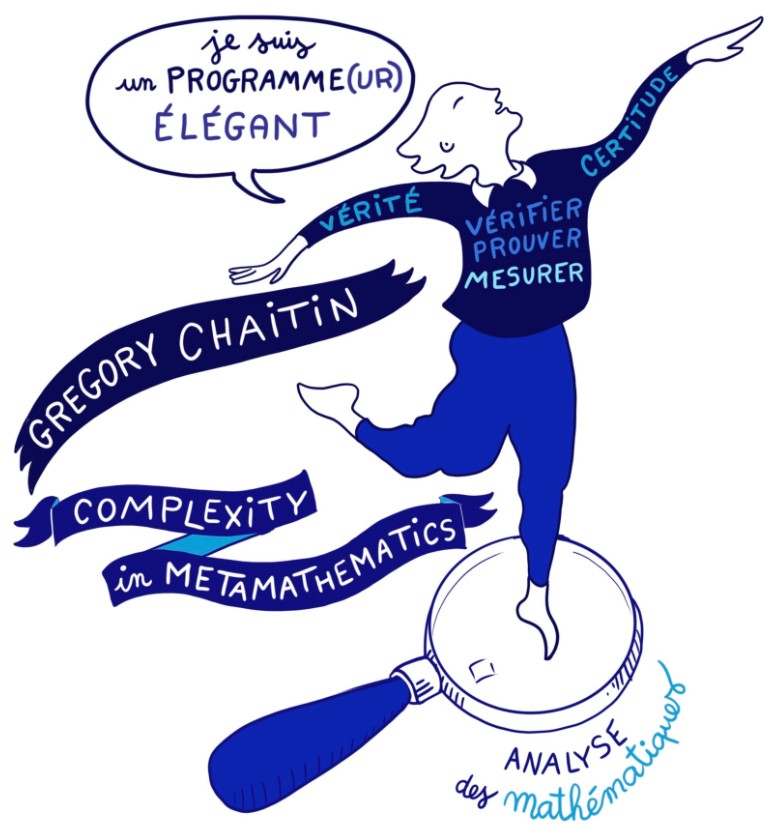
Gregory Chaitin, Complexity in Metamathematics, Friend or Foe? 

UM6P Science Week, 21 February 2023, 1h26mn
Talk followed by a roundtable with Stephen Wolfram, Hervé Zwirn and David Chavalarias
Moderator: Fouad Laroui

Introductory texts (English, French and Arabic) by Hind Aboulazm
Drawing by Sophie Lenormand

In his talk, Gregory Chaitin delves into the intricate realm of metamathematics, contemplating its role as both a companion and adversary to the world of mathematics. Metamathematics, an endeavor aimed at introspectively scrutinizing mathematics through mathematical means, traces its lineage back to Leibniz, its grandparent, and its parental figure, David Hilbert. At its core, this discipline relies upon formal axiomatic systems frozen versions of mathematics viewed from a vantage point above. Such systems serve as the crucible for reasoning and mathematical proof, rigorously delineated to exclude any subjective elements through the apparatus of symbolic logic. Chaitin sketches the historical underpinnings of metamathematics, with Hilbert’s assertion that mathematics is inherently binary black or white when executed within a formal axiomatic system. This approach necessitates defining and formalizing the system’s structure, exemplified by Alfred Tarski’s work on geometry. The Peano arithmetic system and the Zermelo-Fraenkel set theory stand as emblematic formal axiomatic frameworks.

Intriguingly, Chaitin introduces the concept of an “elegant program” —  minimalistic code that yields precise output providing a gateway to the incompleteness theorem. He expounds on the challenges in proving an elegant program, accentuating the limitations of formal axiomatic systems in achieving such a task. The notion of incompleteness, which perturbs the ambition of a universal mathematical framework, becomes a recurrent motif throughout the presentation. Chaitin’s intellectual trajectory culminates in his assertion that any formal axiomatic system —  no matter its intricacy can only grasp an infinitesimal fraction of the boundless intricacies intrinsic to the Platonic realm of pure mathematics. He underscores the necessity of expanding axiomatic horizons and embracing new paradigms to engage with the enigma of undecidability and foster further mathematical progress. While complex and often shrouded in philosophical implications, this endeavor offers a richer perspective into the evolving nature of mathematics and its interactions with the human intellect.
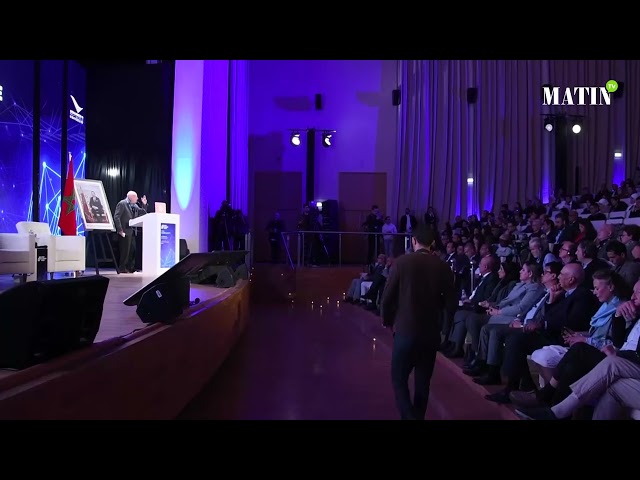
The discussion with Stephen Wolfram, Hervé Zwirn and David Chavalarias that followed the presentation witnessed a synthesis of viewpoints from various luminaries, oscillating between optimism and caution regarding the future of mathematics. Contemplations ranged from the compatibility of mathematics with science despite the specter of incompleteness to the intrinsic value of computational irreducibility in the fabric of existence. Chaitin’s exposition ultimately illuminated the profound interplay between mathematics, cognition, and the boundless tapestry of human inquiry.

Hind Aboulazm

Gregory Chaitin, born in 1947, is an Argentine-American mathematician and computer scientist. From the late 1960s onward, he has made significant contributions to algorithmic information theory and metamathematics, including a notable result in computer theory analogous to Gödel’s incompleteness theorem. Chaitin, along with Andrei Kolmogorov and Ray Solomonoff, is viewed as one of the pioneers of the algorithmic complexity field, often referred to as Solomonoff-Kolmogorov-Chaitin complexity or program-size complexity. The emergence of algorithmic information theory as a core aspect of theoretical computer science, information theory, and mathematical logic owes much to the contributions of figures like Solomonoff, Kolmogorov, Martin-Löf, and Leonid Levin. This subject is frequently taught in computer science courses. Beyond just computer scientists, Chaitin’s research has garnered the interest of numerous philosophers and mathematicians, leading them to explore profound questions in mathematical innovation and digital philosophy.

Gregory Chaitin is author of Information, Randomness & Incompleteness (1987) Algorithmic Information Theory (1987) The Limits of Mathematics (1998), The Unknowable (1999), Exploring Randomness (2001), Meta Math!: The Quest for Omega (2005), Mathematics, Complexity and Philosophy (2011), Gödel’s Way (2012) and Proving Darwin: Making Biology Mathematical (2012).

_________________________________

Gregory Chaitin a exploré profondément les métamathématiques, les considérant à la fois comme alliées et rivales des mathématiques traditionnelles. Les métamathématiques, qui scrutent les mathématiques à travers un prisme mathématique, trouvent leurs racines chez Leibniz, leur précurseur, et David Hilbert, leur principal représentant. Elles s’appuient principalement sur des systèmes axiomatiques formels, qui sont des représentations élevées et structurées des mathématiques. Ces systèmes sont les fondations du raisonnement mathématique, strictement encadrés pour éliminer toute subjectivité grâce à la logique symbolique.

Chaitin a tracé l’histoire des métamathématiques, citant Hilbert qui voyait les mathématiques comme étant fondamentalement dichotomiques  soit vraies, soit fausses  lorsqu’elles sont pratiquées dans un cadre axiomatique formel. Cela nécessite une structuration et une formalisation précises, comme le montrent les contributions d’Alfred  Tarski en géométrie. Le système arithmétique de Peano et la théorie des ensembles de Zermelo-Fraenkel sont des exemples notables de tels cadres.

Chaitin a présenté l’idée du “programme élégant”, un code épuré générant des résultats déterminés, le reliant au théorème d’incomplétude. Il a mis en évidence les défis de prouver un tel programme, montrant les limites des systèmes axiomatiques formels pour cette mission. L’incomplétude, qui remet en question l’idée d’un système mathématique universel, reste un thème récurrent dans son argumentation.

Chaitin a conclu en affirmant que tout système axiomatique, aussi élaboré soit-il, ne peut appréhender qu’une minuscule partie des immenses complexités des mathématiques pures platoniciennes. Il a insisté sur la nécessité de repenser les axiomes et d’embrasser de nouveaux paradigmes pour aborder le mystère de l’indécidabilité et stimuler l’avancement mathématique. Bien que ce sujet soit dense et empreint de réflexions philosophiques, il offre une vision élargie de l’évolution des mathématiques et de leur relation à la pensée humaine.

La discussion post-présentation poursuivie avec Stephen Wolfram, Hervé Zwirn et David Chavalarias a permis de fusionner les opinions de différents experts, oscillant entre espoir et réserve sur le futur des mathématiques. Les réflexions ont varié de la synergie entre mathématiques et science malgré l’incomplétude, à l’importance de l’incompressibilité informatique dans l’essence de la réalité. L’intervention de Chaitin a brillamment souligné le lien entre les mathématiques, la pensée et l’infini voyage de la découverte humaine.

H.A

Gregory Chaitin, né en 1947, est un mathématicien et informaticien argentin-américain. Depuis la fin des années 1960, il a apporté d’importantes contributions à la théorie de l’information algorithmique et à la métamathématique, notamment un résultat notable en théorie informatique analogue au théorème d’incomplétude de Gödel. Chaitin, avec Andrei Kolmogorov et Ray Solomonoff, est considéré comme l’un des pionniers du domaine de la complexité algorithmique, souvent appelée complexité de Solomonoff-Kolmogorov-Chaitin, ou complexité de taille de programme. L’émergence de la théorie de l’information algorithmique comme aspect central de l’informatique théorique, de la théorie de l’information et de la logique mathématique doit beaucoup aux contributions de figures comme Solomonoff, Kolmogorov, Martin-Löf et Leonid Levin. Au-delà du domaine informatique, les recherches de Gregory Chaitin ont suscité l’intérêt de nombreux philosophes et mathématiciens, les incitant à explorer des questions profondes d’innovation mathématique et de philosophie digitale.

Gregory Chaitin est l’auteur de Information, Randomness & Incompleteness (1987) Algorithmic Information Theory (1987) The Limits of Mathematics (1998), The Unknowable (1999), Exploring Randomness (2001), Meta Math!: The Quest for Omega (2005), Mathematics, Complexity and Philosophy (2011), Gödel’s Way (2012) et de Proving Darwin: Making Biology Mathematical (2012).

_________________________________

في محاضرته، تناول غريغوري شايتين عالم الميتاماثيماتيكس المعقد، متأملاً دورها كرفيق وخصم لعالم الرياضيات. الميتاماثيماتيكس، وهي مسعى يهدف إلى فحص الرياضيات من الداخل باستخدام الوسائل الرياضية، تعود أصولها إلى لايبنيتز، جدها، والشخصية الأبوية للميتاماثيماتيكس، ديفيد هيلبرت. في جوهره، يعتمد هذا العلم على الأنظمة المحورية الرسمية – نسخ متجمدة من الرياضيات تُنظر من نقطة مرتفعة. تعمل هذه الأنظمة كمصهر للتفكير والبرهان الرياضي، محددة بدقة لاستبعاد أي عناصر ذاتية من خلال أدوات المنطق الرمزي.رسم شايتين الأسس التاريخية للميتاماثيماتيكس، مع تأكيد هيلبرت أن الرياضيات هي بالفعل ثنائية – سوداء أو بيضاء – عند تنفيذها ضمن نظام محوري رسمي. يتطلب هذا النهج تحديد وتنظيم هيكل النظام، كما هو مبين في أعمال تارسكي حول الهندسة. نظام الحساب البيانو ونظرية المجموعات زيرميلو-فرانكل تعد إطارات محورية رسمية نموذجية.بشكل مثير، قدم شايتين مفهوم “البرنامج الأنيق” – كود مصغر ينتج ناتجًا دقيقًا – مقدمًا بوابة إلى نظرية الاكتمال. تناول التحديات في إثبات برنامج أنيق، مشددًا على حدود الأنظمة المحورية الرسمية في تحقيق مثل هذه المهمة. أصبحت فكرة الاكتمال، التي تزعم طموح إطار رياضي عالمي، نمطًا متكررًا طوال الحديث.بلغت مسيرة شايتين الفكرية ذروتها في تأكيده أن أي نظام محوري رسمي – بغض النظر عن تعقيده – يمكن أن يمسك فقط جزءًا لا يذكر من التعقيدات اللامتناهية المتأصلة في عالم الرياضيات البلاتوني النقي. شدد على ضرورة توسيع الآفاق المحورية واعتناق النماذج الجديدة للتعامل مع لغز العدم وتعزيز التقدم الرياضي. بينما كانت النقاشات معقدة وغالبًا ما كانت محاطة بالآثار الفلسفية، فإن هذا الجهد يقدم منظورًا أغنى حول طبيعة الرياضيات المتطورة وتفاعلاتها مع الفكر البشري.شهدت النقاشات التي تلت العرض تجميع وجهات النظر من مشاهير مختلفين، تتأرجح بين التفاؤل والحذر بشأن مستقبل الرياضيات. تراوحت التأملات بين توافق الرياضيات مع العلوم على الرغم من شبح الاكتمال إلى القيمة المتأصلة لعدم القابلية للحساب في نسيج الوجود. في النهاية، أضاء معرض شايتين التفاعل العميق بين الرياضيات، والإدراك، ونسيج الاستفسار البشري اللامتناهي.
هند ابوالعزم
 
جريجوري  شايتين، وينطق شاي-تين ومولود في 1947، هو عالم رياضيات وعلم الحاسوب أرجنتيني-أمريكي. منذ أواخر ستينيات القرن الماضي، قدم مساهمات كبيرة في نظرية المعلومات الخوارزمية وميتاماثيماتيكا، بما في ذلك نتيجة بارزة في نظرية الحاسوب تشبه نظرياً إلى نظرية جودل الناقصة. يعتبر شايتين، إلى جانب أندريه كولموغوروف وراي سولومونوف، من رواد مجال الكثافة الخوارزمية، وغالبًا ما يشار إليها بكثافة سولومونوف-كولموغوروف-شايتين، أو كولموغوروف أو كثافة حجم البرنامج. ظهرت نظرية المعلومات الخوارزمية كجزء أساسي من علم الحاسوب النظري، ونظرية المعلومات، والمنطق الرياضي بفضل مساهمات شخصيات مثل سولومونوف، كولموغوروف، مارتن-لوف، وليونيد ليفين. وغالبًا ما يتم تدريس هذا الموضوع في دورات علوم الحاسوب. إلى جانب علماء الحاسوب فقط، أثارت أبحاث شايتين اهتمام العديد من الفلاسفة وعلماء الرياضيات، مما دفعهم إلى استكشاف أسئلة عميقة في الابتكار الرياضي والفلسفة الرقمية.
 

L’UM6P questionne la complexité

Loading video

La troisième édition de la Semaine de la Science de l’Université Mohammed VI Polytechnique (UM6P), lancée du 21 au 26 février, se déroule cette année sur les campus de Laâyoune et de Benguérir. La complexité est mise en perspective par des scientifiques de renom et des artistes ainsi que les étudiants.

Le coup d’envoi est donné. La troisième édition de la Semaine de la Science est lancée ce lundi à l’Université Mohammed VI Polytechnique (UM6P) sur les campus de Benguérir et Laâyoune. En présence d’un panel d’éminents scientifiques, experts et penseurs venus du monde entier, le président de l’UM6P, Hicham El Habti, a donné le ton de cette semaine de conférences et d’ateliers : « C’est le début de quelque chose de pertinent. »

En effet, les organisateurs ont jeté leur dévolu sur la complexité comme sujet thématique de cette Semaine de la Science. D’après Edgar Morin, sociologue et philosophe français, la complexité, communément appelée « l’effet papillon », c’est quand « le tout est supérieur à la somme des parties ».

Un sujet d’actualité pour Hicham El Habti qui a justifié le choix du sujet : « Pour essayer de sauver le monde dans un contexte de crises multiples, plusieurs disciplines doivent se mélanger et ne pas être traitées individuellement. C’est plus complexe. » Et de préciser qu’à l’UM6P, les étudiants sont formés et travaillent dans l’objectif de répondre à ce challenge qui touche non seulement l’Afrique mais le monde avec une solution durable et pertinente.

Réda Benkirane, membre du Chair Complexité et Humanités de l’UM6P, a, quant à lui, résumé l’objectif de cette troisième édition de la Semaine de la Science : « Comment faire beaucoup mieux avec beaucoup moins ? » Autrement dit, la complexité est, à la fois, un défi actuel et une potentielle réponse aux problématiques modernes. La complexité rassemble toutes les disciplines scientifiques qui peuvent échanger leurs savoirs et leurs connaissances.

D’après Fouad Laroui, économiste et ingénieur marocain, membre du comité d’organisation, tel était également l’un des objectifs ayant présidé au choix de la complexité comme sujet. Ouverte au grand public, l’Université Mohammed VI Polytechnique se transforme ainsi, le temps d’une semaine, en une pépinière de savoirs et d’échanges, d’après les mots de Réda Benkirane. Une rencontre entre les sciences et la culture. En outre, le lancement de la Semaine de la Science a été l’occasion de rappeler le programme de l’événement qui se déroule jusqu’au 26 février.

Au menu, des conférences avec des scientifiques, des experts et des penseurs de renoms tels que Edgar MorinStuart KauffmanIvar Ekeland et Luc Steel. Chacun traite de la complexité à travers le prisme de sa discipline. De l’intelligence artificielle à la biodiversité en passant par l’économie. Les Départements de l’UM6P peuvent, quant à eux, mettre en avant et échanger sur leurs travaux.

En marge de ces rencontres scientifiques, des événements culturels sont également organisés afin d’aborder l’expression artistique de la complexité. « Les artistes ont leur propre perception de la réalité et, par conséquent, de la complexité, a souligné Réda Benkirane. Ils ont donc toute la légitimité à être entendus. » Au programme : talk-récital de Giovanni Bellucci, chorale menée par Ikram Chairi et concert de musique gnaoua par Hamid Kasri.


World-Acclaimed Scientists Tackle ‘Complexity at UM6P

Sara Zouiten, ‘World-Acclaimed Scientists Tackle ‘Complexity’ at UM6P Science Week’, Morocco News, Feb. 20, 2023
https://www.moroccoworldnews.com/2023/02/354130/world-acclaimed-scientists-tackle-complexity-at-um6p-science-week

[embedyt] https://www.youtube.com/watch?v=oUZkycgnA2s[/embedyt]

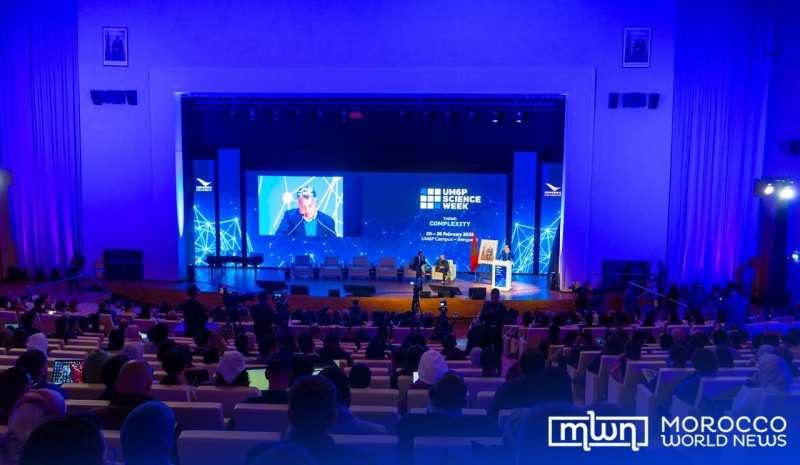
Rabat – The third edition of the UM6P Science Week kicked off on Monday at Mohammed VI Polytechnic University’s campus in Ben Guerir, bringing together high-caliber scientists, thinkers, and researchers from across the world.

The event, which is taking place between February 20 and 26, features a set of conferences, musical performances, reading circles and other activities, with each participant tackling the theme of “complexity” in relation to their field of expertise.

The UM6P Science Week “plays a catalytic role in the life of the university,” Moroccan professor and sociologist Reda Benkirane emphasized in an interview with Morocco World News, adding that the event offers students and participants the opportunity to exchange in a “multidisciplinary manner” with “the greatest scientists of our time.”

The ‘beginning of something beautiful’

Speaking at the opening of the event, UM6P President Hicham El Habti also highlighted the importance of the university’s science week, saying it aligns with the UM6P’s vision to promote applied scientific research.

El Habti hopes that the event would be “the beginning of something beautiful,” and contribute to creating a “more realistic impact.” In this regard, he called on the participants and UM6P students to seize the opportunity and benefit from the expertise and knowledge of the participating scientists. “Dare to explore,” he stressed.

Explaining the reasoning behind this edition’s theme, Moroccan academic and writer Fouad Laroui emphasized that complexity is “common in all domains” and is present in the entirety of the human experience.

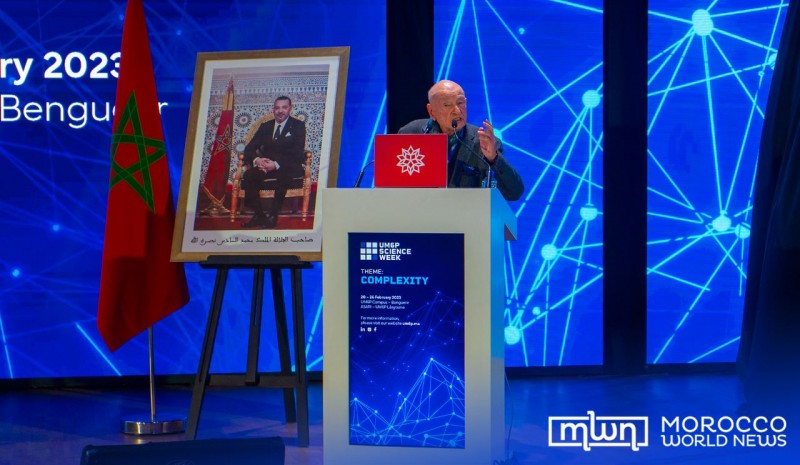
Moroccan academic Fouad Laroui speaking at the event

Benkirane, who is also the Chair of Complexities and Humanities at the Africa Business School, echoed Laroui’s statement, emphasizing the relevance and presence of complexity in all components of humanity. “Complexity is all around us,” he said.

However, Benkirane warned that the complexity in play could have a reverse impact in the future, in a “butterfly effect” fashion. “Complexity is somehow taking revenge on us,” he said, highlighting the many crises and challenges that humanity has faced over the past decades, from 9/11 to the covid-19 pandemic. “We are living in a dark age of complexity.”

Under the theme of “Complexity, Golden Age, Dark Age,” Benkirane’s presentation indicated that regardless of its future impact, which could be better or worse, complexity will undoubtedly be more “amplified and generalized .”

Chair of Complexities and Humanities at the Africa Business School Reda Benkirane

Complexity in Times of Crisis

Like Benkirane, French philosopher and sociologist Edgar Morin, spoke about the “challenges of complexity in times of crisis.” The well-respected 101-year-old social scientist has witnessed some of humanity’s biggest crises, challenges, and prominent events, including his participation in World War II.

“One cannot understand a system, unless one understands the properties of all its components,” Morin emphasized, explaining that life does not follow a linear order. The French sociologist also highlighted the complexity of the relations that govern people and institutions, saying that “any autonomy is also dependency.”

Several unexpected scenarios unfold in times of uncertainty and interlinked crises, Mourin noted, explaining that difficult times can prompt creativity and innovative solutions, as well as have severe repercussions and trigger other crises.

French philosopher and sociologist Edgar Morin

Talking about the crises that have engulfed the world in recent decades, Mourin said that they tend to pile up and come one after the other. He gave the example of the COVID-19 pandemic and the war in Ukraine, and the effect they have had on globalization. Describing it as “the crisis of globalization,” he said that the ongoing war has created obstacles in the face of the years-long efforts to unite the world.

In addition, the complexity of the COVID-19 crisis provoked several social, domestic, and economic crises, such as the gas and energy crisis and food insecurity in Africa. “The crisis happened during a time when the planet was in crisis,” he said in reference to the challenges that currently face humanity, such as climate change, which has aggravated in light of the current global context.

Morin drew attention to the difficult dilemma humans are bound to encounter as they grapple with these successive crises that are happening simultaneously and are affecting several domains. “This is humanity in 2023 … encountering crises that are inflating one another.”

Read also: A Panel’s Fun Foray Into the Tragic Geopolitics of Climate Change 

“Humanity has no way of managing them [the challenges],” the French scientist said, stressing that “no entity can manage this crisis.” He argued that “war creates illusion and hatred,” encouraging people to promote and engage in a globalization that is based on “solidarity.”

Since all humans are affected by these crises, they must come together in pursuit of collective action, he stressed.

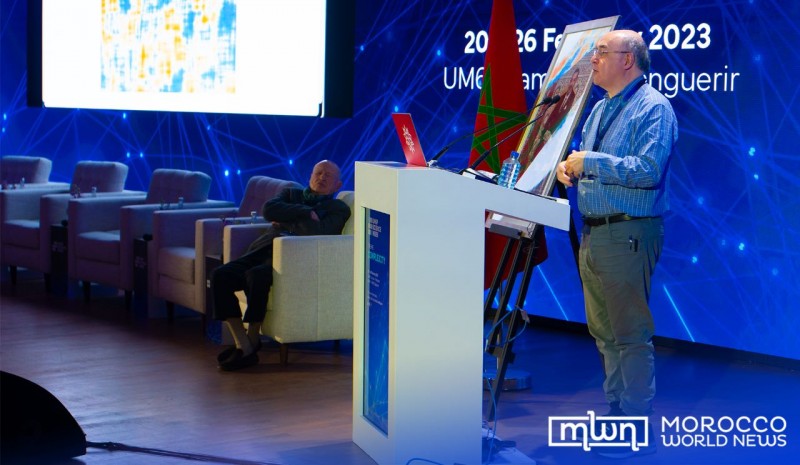
Meanwhile, Stephen Wolfram, a British-American scientist and CEO of Wolfram Research, spoke of the “foundation and implications of complexity.” He discussed his concept of the “Ruliad,” which is “the result of following all possible computational rules in all possible ways.”

British-American scientist Stephen Wolfram

Explaining the complexity of the universe, Wolfram said that “the behavior could be simple, but the result we get from it is complex.” “The universe is running by all possible rules,” he added, explaining that it is difficult to pinpoint the very structure that governs the world.

Wolfram gave the example of ChatGPT – an Artificial Intelligence powered chatbot – during his presentation, saying that the AI-powered tool is capable of generating human-like language by implicitly learning the syntactic grammar of English.

While many think that a complex process comes into play to produce ChatGPT’s human-like language, the English-American scientist said that it simply uses the humans’ repeated structure of meaning and generalization of logic.

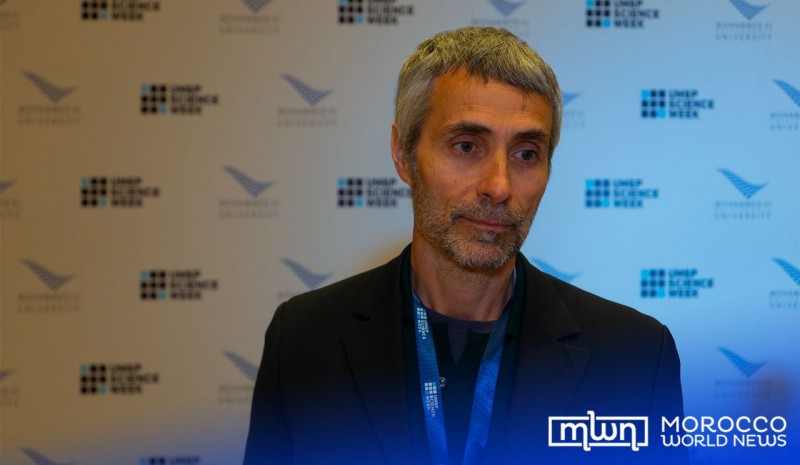
Other participants at the event include French philosopher, sociologist, and professor Raphael Liogier, who told Morocco World News about the goal he aims to achieve through his participation in the UM6P Science Week. He said he seeks to fight against two widely spread prejudices.

French professor and sociologist Raphael Liogier

One of those prejudices is the belief that human beings’ intelligence and conscience are the result of their complexity, Liogier explained.

The other prejudice Liogier aims to debunk is humans’ belief that they are more complex than other animals. For him, humans are in fact “complexed” animals that seek to compensate for their fragility and weakness. He told MWN: “We are complexed before we are complex.” 

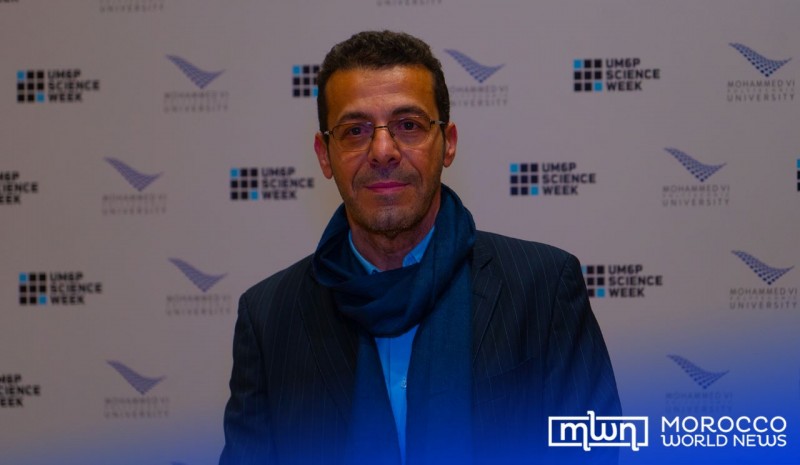
Meanwhile, President of the Makassed University of Beirut Hassan Ghaziri will tackle the way the “notion of complexity is transforming the engineering areas,” as well as its role in finding new ways to solve our current issues, he told Morocco World News.


Ghaziri, who is also a professor of machine learning, argued that engineers are the “agent of transformation” in our current world, explaining that at this moment the world faces “deep crises” due to new technologies, including Artificial Intelligence (AI).


Professor of machine learning and President of the Makassed University of Beirut Hassan Ghaziri

© Morocco World News. All Rights Reserved.


About the Chair

Attached to the Africa Business School (ABS), the Chair of Complexities ∞ Humanities is tasked with reinforcing the ties with other UM6P Schools and Departments by facilitating:

•   teachings on complexity sciences delivered within ABS and UM6P and their articulation with human and managerial sciences

•   their dissemination through cultural and scientific events as well as publications and multimedia productions

•   their “insemination” through workshops, case studies, and field surveys

The Chair’s various activities will focus on:

•   deepening the specifically human and social dimensions of complexity

•   the contribution of the Chair’s themes to the managerial approach of organizations

•   the spirit of creativity and innovation through a circulation of ideas and concrete initiatives all oriented towards the ‘learning by doing’ approach.

•   the emulation or implementation of multidisciplinary approaches, transversality, and critical thinking

The objective of the Chair of Complexities ∞ Humanities is to support actors within UM6P in their processes of transformation and learning. By providing young managers, engineers, scientific researchers, and students – who are well-trained in cutting-edge fields – with a mastery of transdisciplinary tools, the ambition is to reinforce their self-reliance and empower them with a humanist and civic culture.

Reda Benkirane, Affiliate Full Professor, is in charge of this Chair.

Reda Benkirane, a sociologist and doctor in philosophy (study of systems), has a dual background as a social science researcher and an expert in international affairs. His multidisciplinary approach, empirical knowledge and publications are all based on a methodological approach which relies on the heuristics of dialogue (as a path to knowledge otherwise out of reach), sustained attention to otherness, diversity and singularity, the understanding of nonlinear and contradictory phenomena, deep listening and participant observation.

__________________________________

La Chaire Complexités ∞ Humanités

Rattachée à l’Africa Business School (ABS), la Chaire Complexités ∞ Humanités (Chair of Complexities ∞ Humanities) est appelée à renforcer les liens avec les autres écoles et départements de l’UM6P en favorisant :

•   des enseignements dispensés au sein de l’ABS et à l’UM6P sur les sciences de la complexité et leur articulation avec les sciences humaines et managériales

•  leur dissémination via des rencontres scientifiques et culturelles ainsi que des publications et des productions multimédias

•   leur insémination au travers d’ateliers, études de cas, enquêtes de terrain

Les diverses activités mettront l’accent sur :

•  l’approfondissement de la dimension spécifiquement humaine et sociale de la complexité

•  l’apport des thématiques de la chaire à l’approche managériale des organisations

• l’esprit de créativité et d’innovation au travers de la circulation des idées et d’initiatives concrètes toutes axées sur l’apprentissage par « le faire » (learning by doing)

•  l’émulation ou la mise en acte des approches multidisciplinaires, de la transversalité et du sens critique

La finalité de la Chaire Complexités ∞ Humanités est d’accompagner des acteurs au sein de l’UM6P dans le cadre des processus en cours de transformation et d’apprentissage. En dotant de jeunes cadres managériaux, ingénieurs, chercheurs scientifiques et étudiants – par ailleurs excellemment formés dans des domaines de pointe – d’une maîtrise des outils de la « transdiscipline », l’ambition est de renforcer leur autonomie (self-reliance) et de les « empuissanter » de manière à les doter d’une culture humaniste et citoyenne. 

Reda Benkirane, professeur titulaire affilié, est en charge de cette chaire.

Reda Benkirane, sociologue, docteur en philosophie (étude des systèmes), a un double parcours de chercheur en sciences sociales et d’expert en affaires internationales. Son approche multidisciplinaire, ses connaissances empiriques et ses publications procèdent d’une méthodologie mobilisant le potentiel heuristique du dialogue (comme voie d’accès au savoir), l’attention soutenue à l’altérité, la diversité et la singularité, la saisie des phénomènes non linéaires et contradictoires, l’écoute profonde et l’observation participante.

__________________________________

الكرسيّ العلميّ تعقيدات ∞ إنسانيّات

يرتبط الكرسيّ العلميّ ” تعقيدات ∞ إنسانيّات ” تنظيميّا بالمدرسة العُليا الإفريقيّة لإدارة الأعمال وهو مدعوّ لتعزيز الرّوابط مع الكلّيات والمدارس العُليا المُنضوية ضمن جامعة مُحمّد السّادس مُتعدّدة التخصّصات التقنيّة وذلك من خلال ما يلي:

 ·          تدريس عُلوم التّعقيد ضمن برامج المدرسة العليا وجامعة محمد السّادس متعددة التخصصات التقنية من زاوية ارتباطِها بالعلوم الإنسانية والإدارية.

·         التّعريف بعُلوم التّعقيد وشرحها من خلال اللّقاءات العلميّة والثقافيّة بالإضافة إلى النّشر والوسائط الإعلاميّة.

·         إثراء المضامين عبر ورشات العمل ودراسات الحالات والدّراسات الميدانيّة.

 وستُركّز مُختلف الأنشطة على ما يلي:

 ·         تعميق فهم أبعاد التّعقيد لا سيّما الإنسانيّة والاجتماعيّة منها.

·         تعزيز مُساهمة الموضوعات التي يتناولها الكرسيّ في إثراء النّقاش حول منهجيّة تدبير المؤسّسات.

·         تعزيز روح الإبداع والابتكار من خلال تداول الأفكار والمُبادرات العمليّة المُتمحورة حول التّعلّم من خلال المُمارسة.

·         المُحاكاةُ أو التّجريب العمليّ لمناهجَ مُتعدّدة الاختصاصات ذات بُعد تقاطعيّ وقائمة على الحسّ النقديّ.

 وإذ تتمثّل غاية الكرسيّ العلميّ ” تعقيدات ∞ إنسانيّات ” في مُرافقة الأطراف الفاعلة داخل جامعة مُحمّد السّادس مُتعدّدة التخصّصات التقنيّة ضِمن عمليّة التّعلّم والتحوّل المُستمرّين، فإنّ هذا الكرسيّ يتوجّه كذلك للمُسيّرين الشّباب والمُهندسين والباحثين في شتّى المجالات العلميّة وعموم الطّلبة. وإذا كانت هذه الفئات قد تلقّت تدريبا مُتميّزا في المجالات الفنّية الدّقيقة المُتطوّرة، فإنّ الطّموح يتمثّل في تمكينها من أدوات ” عابرة للمنهجيّات ” بما يُعزّزُ لديها مَلَكَةَ الاستقلاليّة (الاعتماد على الذّات) وتقوية قدراتها بما يمنحُها ثقافة إنسانيّة وحضاريّة شاملة.

رضا بنكيران هو أستاذ منتسب لجامعة مُحمّد السّادس مُتعدّدة التخصّصات التقنيّة، مسؤول عن الكرسيّ العلميّ ” تعقيدات وإنسانيّات “.

رضا بنكيران هو عالم اجتماع مُتحصّل على الدكتوراه في الفلسفة في موضوع دراسة الأنظمة. وقد عمل في إطار مسيرته العلميّة والمِهنيّة في مسارات مزدوجة كباحث في العلوم الاجتماعية وخبير في الشؤون الدولية. وإذ تتمحور اهتماماته حول المنهجيّة مُتعدّدة الاختصاصات والمعارف التّجريبيّة، فإنّ منشوراته العلميّة كثيرا ما تستلهمُ خصوصيّتها من منهجيّة تُكثّف الإمكانيّات الاستكشافيّة للحوار (باعتباره سبيلا للمعرفة)، والانتباه المُستمرّ للآخر بالإضافة إلى خاصيّات التنوّع والتفرّد وتلمّس الظّواهر غير الخطّية والمُتناقضة والاستماع المُعمّق والمُشاهدة التّشاركيّة.

La Complexité, vertiges et promesses. Histoires de sciences

A la rencontre des penseurs de la complexité

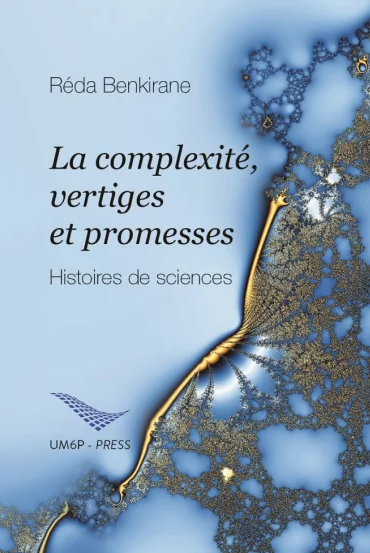
ImageRéda Benkirane, La Complexité, vertiges et promesses. Histoires de sciences. Nouvelle édition, Benguerir, UM6P-Press, 2023. ISBN: 978-9920-41-013-7. 

Qu’il y a-t-il de commun entre la complexité d’un réseau informatique et celle des insectes sociaux ? Quelles sont les possibilités et les limites de l’intelligence artificielle ? Peut-on réinventer la vie, maîtriser les croisements génétiques ? Quelles promesses et dangers faut-il voir dans l’essor de la biologie ? L’incertitude, l’imprévisible, le hasard sont-ils des manifestations de notre ignorance ou bien plutôt une donnée fondamentale ? Dieu joue-t-il aux dés ? L’Univers est-il fini ou infini, mortel ou éternel ? Y aurait-il une « théorie du tout » ? Voici quelques-unes des questions fascinantes que soulèvent ces histoires de sciences. Le livre dresse en outre une galerie de portraits de savants à travers laquelle transparaissent la qualité des témoignages et surtout la diversité des éclairages recueillis. Derrière quelques-uns des plus grands noms des sciences, des hommes se profilent, montrant leurs sensibilités, leurs différences et leurs désaccords, leurs limites et leurs espoirs. C’est finalement sa propre histoire que chacun raconte de la sorte, sous le regard tantôt complice tantôt critique de Réda Benkirane. Cette édition est introduite par une préface de l’auteur qui resitue le livre par rapport à l’état actuel des recherches sur la complexité.  Entretiens avec, par ordre d’apparition : Edgar Morin, Ilya Prigogine, Neil Gershenfeld, Daniel Mange, Jean-Louis Deneubourg, Luc Steels, Christopher Langton, Francisco Varela, Brian Goodwin, Stuart Kauffman, Bernard Derrida, Yves Pomeau, Ivar Ekeland, Gregory Chaitin, John Barrow, Laurent Nottale, Andrei Linde, Michel Serres.

__________________________________

Sociologue, docteur en philosophie, Réda Benkirane est expert en relations internationales auprès des Nations Unies et d’organisations non gouvernementales à Genève. Il est professeur titulaire affilié à l’Africa Business School de l’Université Mohamed VI Polytechnique, en charge de la chaire Complexités ∞ Humanités. Il enseigne également à l’université de Fribourg en Suisse. Ses recherches empiriques ont porté principalement sur l’urbanité, la complexité, la radicalité et l’islamité.

__________________________________

Disponibilité en librairie :

Librairies Eyrolles, campus de l’UM6P à Rabat et Benguerir

Librairie-papeterie Chatr , Avenue Mohamed V Quartier Guéliz 40 000 MARRAKECH

Par internet auprès de Bloom Books: https://www.bloombooks.ma/science-et-tech/p24346-la-complexite-vertiges-et-promesses.html

__________________________________

Meeting the Thinkers of Complexity

Reda Benkirane, Complexity, vertigoes and promises. Histories of sciences. New Edition, Benguerir, UM6P-Press, 2023 – ISBN: 978-9920-41-013-7

What do the complexity of a computer network and that of social insects have in common? What are the possibilities and limitations of artificial intelligence? Can we reinvent life, master genetic crossovers? What promises and dangers should we see in the development of biology? Are uncertainty, unpredictability, and randomness manifestations of our ignorance or rather fundamental data? Does God play dice? Is the universe finite or infinite, mortal or eternal? Could there be a “theory of everything”?

Here are some of the fascinating questions explored in these histories of science.

The book is also a portrait gallery of scientists, revealing the quality of testimonies and, above all, the diversity of gathered insights. The men behind some of science’s greatest names reveal their sensitivity, their differences and disagreements, their limits, and their hopes. Under Réda Benkirane’s gaze, at times complicit, at others critical, each person in the end tells their own story.

Containing eighteen chapters and an annotated bibliography, this edition is introduced by a new preface that situates the book in relation to the current state of research on complexity. 

Interviews with, in order of appearance: Edgar Morin, Ilya Prigogine, Neil Gershenfeld, Daniel Mange, Jean-Louis Deneubourg, Luc Steels, Christopher Langton, Francisco Varela, Brian Goodwin, Stuart Kauffman, Bernard Derrida, Yves Pomeau, Ivar Ekeland, Gregory Chaitin, John Barrow, Laurent Nottale, Andrei Linde, Michel Serres.

__________________________________

A sociology researcher with a doctorate in philosophy, Reda Benkirane is an expert in international relations working for  UN agencies and NGOs in Geneva. An affiliate full professor at the Africa Business School of Mohamed VI Polytechnic University, he is in charge of the Chair of Complexities∞Humanities. He also teaches at the University of Fribourg in Switzerland. His empirical research covers mainly urbanization, complexity, radicalism, and contemporary issues on Islam.

__________________________________

لقاء مفكري التعقيد

ما الذي يشترك فيه تعقيد شبكة الحاسوب وتعقيد الحشرات الاجتماعية؟ ما هي إمكانيات وحدود الذكاء الاصطناعي؟ هل يمكننا إعادة اختراع الحياة، والتحكم في التقاطعات الجينية؟ ما الوعود والمخاطر التي يجب أن نراها في ارتفاع علم الأحياء؟ هل الغموض وعدم القدرة على التنبؤ والفرص هي مظاهر لجهلنا أم جوانب أساسية؟ هل الله يلعب بالنرد؟ هل الكون محدود أم لا نهائي، مؤقت أم أبدي؟ هل يمكن أن يكون هناك “نظرية لكل شيء”؟

هذه بعض الأسئلة المثيرة التي طرحتها هذه القصص العلمية. 

يقدم الكتاب أيضًا معرضًا لصور العلماء من خلاله يصبح جودة الشهادات و، قبل كل شيء، تنوع الآراء المجمعة، واضحة. خلف بعض أعظم أسماء العلم، تظهر الأفراد، مكشفة عن حساسياتهم، الاختلافات، الخلافات، الحدود، والآمال. في النهاية، يروي كل منهم قصتهم بهذه الطريقة، تحت نظرة رضا بنكيران ، التي تكون أحيانًا متواطئة وأحيانًا نقدية.

تم تقديم هذه الطبعة بمقدمة من الكاتب تحدد الكتاب فيما يتعلق بالحالة الحالية للبحث عن التعقيد. يتكون الكتاب من مقدمة، وثمانية عشر فصلاً، وقائمة مراجع مذيلة.

مقابلات مع، حسب ترتيب الظهور: إدغار موران، إيليا بريغوجين، نيل جيرشنفيلد، دانيال مانج، جان-لوي دينوبورغ، لوك ستيلز، كريستوفر لانغتون، فرانسيسكو فاريلا، براين جودوين، ستيوارت كوفمان، برنارد ديريدا، إيف بوميو، إيفار إيكيلاند، غريغوري شايتين، جون بارو، لوران نوتال، أندري ليند، ميشيل سيريس.

__________________________________

سوسيولوجي، حاصل على دكتوراه في الفلسفة، رضا بنكيران خبير في العلاقات الدولية في الأمم المتحدة والمنظمات غير الحكومية في جنيف. هو أستاذ مرتبط بالكامل في كلية الأعمال الأفريقية لجامعة محمد السادس التقنية، وهو مسؤول عن كرسي التعقيد ∞ الإنسانيات. يدرس أيضًا في جامعة فريبورغ في سويسرا. ركزت أبحاثه التجريبية بشكل رئيسي على الحضرية، التعقيد، التطرف، والإسلامية.