De Casablanca à Ouaouizalte: parcours d’une architecte. Selma Zerhouni
Author: cch_admin
From Bolivia to Morocco: Anthropology of Health in Indigenous Communities. Sarah Alami
Le leader serviteur : sens et puissance d’un dévouement altruiste. Wafae Hajjani
Science Week 2025 – Le Vivant: rétrospective et prospective
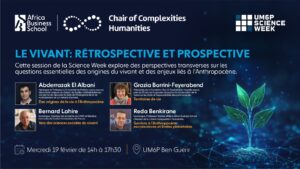
Le 19 février 2025, la Chaire Complexités ∞ Humanités a organisé une session intitulée « Le Vivant : rétrospective et prospective », dans le cadre de la Science Week 2025 de l’UM6P.
Comment et quand est apparue la vie multicellulaire complexe? Comment les sciences sociales et humaines peuvent-elles dialoguer et interagir avec les sciences du vivant? Peut-on encore préserver la diversité du vivant, intriquer à nouveau nature et culture, relier sociétés humaines et animales? Une politique du vivant est-elle envisageable? L’humanité peut-elle survivre à ses impacts biosphérique et géologique?
Afin d’explorer ces thématiques, des chercheurs internationaux ont partagé leurs réflexions sur l’avenir de la science et de l’humanité.
𝗔𝗯𝗱𝗲𝗿𝗿𝗮𝘇𝗮𝗸 𝗘𝗟 𝗔𝗟𝗕𝗔𝗡𝗜 – 𝘋𝘦𝘴 𝘰𝘳𝘪𝘨𝘪𝘯𝘦𝘴 𝘥𝘦 𝘭𝘢 𝘷𝘪𝘦 𝘢 𝘭’𝘈𝘯𝘵𝘩𝘳𝘰𝘱𝘰𝘤𝘦𝘯𝘦
𝗕𝗲𝗿𝗻𝗮𝗿𝗱 𝗟𝗔𝗛𝗜𝗥𝗘 – 𝘝𝘦𝘳𝘴 𝘥𝘦𝘴 𝘴𝘤𝘪𝘦𝘯𝘤𝘦𝘴 𝘴𝘰𝘤𝘪𝘢𝘭𝘦𝘴 𝘥𝘶 𝘷𝘪𝘷𝘢𝘯𝘵
𝗚𝗿𝗮𝘇𝗶𝗮 𝗕𝗢𝗥𝗥𝗜𝗡𝗜-𝗙𝗘𝗬𝗘𝗥𝗔𝗕𝗘𝗡𝗗 – 𝘛𝘦𝘳𝘳𝘪𝘵𝘰𝘪𝘳𝘦𝘴 𝘥𝘦 𝘷𝘪𝘦
𝗥𝗲𝗱𝗮 𝗕𝗘𝗡𝗞𝗜𝗥𝗔𝗡𝗘 – 𝘚𝘶𝘳𝘷𝘪𝘷𝘳𝘦 𝘢 𝘭’𝘈𝘯𝘵𝘩𝘳𝘰𝘱𝘰𝘤𝘦𝘯𝘦 : 𝘦𝘹𝘤𝘳𝘰𝘪𝘴𝘴𝘢𝘯𝘤𝘦𝘴 𝘦𝘵 𝘭𝘪𝘮𝘪𝘵𝘦𝘴 𝘱𝘭𝘢𝘯𝘦𝘵𝘢𝘪𝘳𝘦𝘴
Débat avec le public
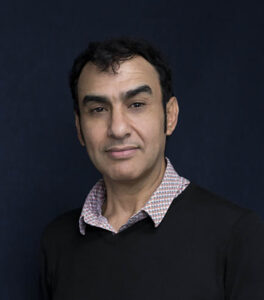 |
Abderrazak El Albani est géologue et professeur à l’Université de Poitiers, connu pour sa découverte majeure au Gabon de fossiles multicellulaires qui ont permis de repousser la date de l’émergence de la vie multicellulaire de 1,5 milliard d’années. Ses travaux ont plusieurs fois eu un impact déterminant faisant l’objet des couvertures des revues Nature et Science, comme pour le cas de sa découverte au Maroc de deux nouvelles espèces de trilobites fossiles vieux de 515 millions d’années. Il est co-auteur notamment de Comment tout a commencé sur la Terre. Le récit d’une incroyable découverte (humenSciences, 2020) et de Aux origines de la vie – une nouvelle histoire de l’évolution (Dunod, 2016). |
 |
Bernard Lahire est sociologue, directeur de reherche au CNRS et membre honoraire de l’Institut Universitaire de France. Affilié à l’Ecole Normale Supérieure de Lyon, ses travaux portent sur la socialisation pendant l’enfance, la culture et les inégalités sociales. Il est l’auteur de très nombreux ouvrages dont L’Homme pluriel (Nathan, 1998), Monde pluriel : penser l’unité des sciences sociales (Seuil, 2012), Les structures fondamentales des sociétés humaines (La Découverte, 2023) et Vers une science sociale du vivant (La Découverte, 2025). |
 |
Grazia Borrini-Feyerabend travaille depuis près de trente ans sur la gouvernance pour la conservation de la nature et les droits et responsabilités des communautés, souvent en étroite collaboration avec l’Union internationale pour la conservation de la nature (UICN), pour laquelle elle a développé et mis en œuvre le programme de politique sociale au début des années 1990. Elle est actuellement présidente de la Fondation Paul K. Feyerabend. En 2014, elle a reçu le Fred Packard International Parks Merit Award. Elle vient de publier Territories of Life. Exploring vitality of governance for conserved and protected areas (The ICCA Consortium, 2024). |
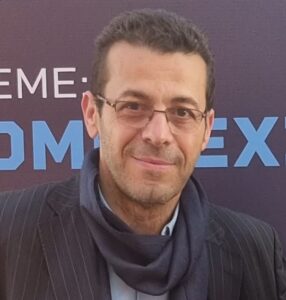 |
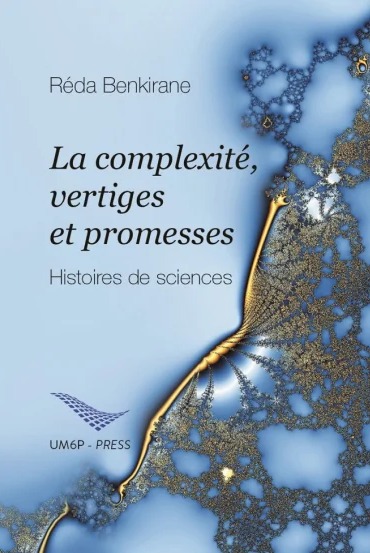
Reda Benkirane, sociologue, professeur titulaire affilié à l’Africa Business School, dirige la Chaire Complexités ∞ Humanités. Il enseigne également à l’université de Fribourg (Suisse). Il est expert en affaires internationales auprès d’agences des Nations-Unies, d’ONGs et d’institutions culturelles et médiatiques. Ses recherches empiriques ont porté principalement sur l’urbanité, la complexité, la radicalité et l’islamité. ll est l’auteur de plusieurs ouvrages dont notamment La Complexité, vertiges et promesses. Histoires de sciences (UM6P-Press, 2023, Le Pommier, 2013). |
World Conference on Complex Systems – 2024
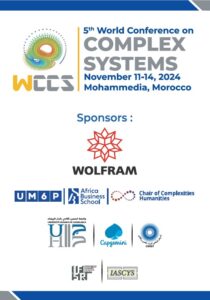
World Conference on Complex Systems, 5th edition, November 11-14, 2024
The Chair of Complexities ∞ Humanities had the pleasure of being a leading partner and sponsor of the World Conference on Complex Systems (WCCS), which took place from November 11 to 14 in Mohammedia, Morocco.
The Moroccan Society of Interdisciplinary Sciences organized the WCCS’s 5th edition in partnership with the IEEE Technology and Engineering Management Society (TEMS), the International Federation for Systems Research (IFSR), and the International Academy for Systems and Cybernetic Sciences (IASCYS).
The conference provides “an international forum for researchers and Ph.D. students to present recent research results, address new challenges, and discuss emerging trends in complex systems and interdisciplinary science. It aims to foster a debate on the most relevant methodologies and approaches for understanding, modeling, simulating, predicting, evaluating, and mastering societal, ecological, biological, and engineered complex systems.”
See the WCCS full program here
Opening Keynote Speech
Reda Benkirane, “Complexity in the 21st Century: From the Limits of Growth to the Growth of Limits”
Reda Benkirane, the Chair holder, delivered the opening keynote speech titled “Complexity in the 21st Century: From the Limits of Growth to the Growth of Limits.”
Chair of Complexities ∞ Humanities Session
We also organized a special session on Tuesday, November 12th, featuring world-renowned complexity scientists Hervé Zwrin, Gregory Chaitin, Jean-Paul Delahaye, and Hugues Bersini.
Hervé Zwirn, Déterminisme et prédictibilité
Gregory Chaitin, Von Neumann on Biology and Life as Evolving Software
Jean-Paul Delahaye, La complexité de Chaitin-Kolmogorov et la profondeur logique de Bennett
Hugues Bersini, Algocracy and Public Services
Contre-pouvoirs. Penser, agir et résister dans la complexité. Miguel Benasayag
Science Week 2023 / Impromptu Conversations Impromptues
Here is a series of conversations and interviews conducted by the UM6P team with some of the speakers from the UM6P Science Week event on Complexity.
Ivar Ekeland, mathematician and economist
David Napier, anthropologist
Luc Steels, computer scientist
David Chavalarias, mathematician
Dany-Robert Dufour, philosopher
Fusion of science and culture, Key to the 21st century, by Mahdi Elmandjra
Fusion of science and culture
Key to the 21st century
by Mahdi Elmandjra
Article published in Futures, April 1990
Mahdi Elmandjra (1933–2014) was a Moroccan futurologist, economist and sociologist. He is one of the founders of the International Federation for Future Studies (Futuribles). This essay is an edited version of a paper given to a UNESCO Symposium on ‘Science and Culture for the 21st Century: Agenda for Survival’, Vancouver, Canada, 10-15 September 1989.
This essay takes as its premise that long-term human survival requires the development of a new alliance between science and culture to the point of fusion. Geopolitical rupture with the past and cultural diversity will shape the norms and values underlying the future development of science and technology, with a shift occurring from previous science and technology development models. Science will thus require new models of cultural communication based on reciprocal relations among all humanity without the hegemony of Western values so that humanity can live peacefully with itself and the environment.
It is commonly accepted that humanity will survive together or vanish collectively. The question of survival at what cost? It raises more complex and delicate aspects related to values and hence to culture.
Survival calls for solidarity in space –“participation”- and solidarity in time –“anticipation”. The major obstacles to the satisfaction of these prerequisites are (1) the great economic disparities to be found within and between countries and the consequent social inequity; (2) the hegemony, over the past 200 years, of the “Western” or “Judeo-Christian” system of sociocultural values; and (3) maladapted learning processes and mental structures for coping with an unprecedented acceleration of historical events and a rapid rate of change, which call for greater foresight and much more balanced cultural communication.
New alliance
The basic assumption of this article is that survival cannot be ensured without a “new alliance” between science and culture to the point of fusion. The industrial revolution has lived on the vision of a society with “two cultures” one of science and one of non-science. Post-industrial society will inevitably overcome this dichotomy as we move from a civilization of raw materials, production, and capital to one of knowledge, information, and a materialization of the economy.
This fusion will raise numerous problems, including the reconsideration of the long-standing credo concerning the universality and neutrality of science. Questioning this dogma is essential to overcome the equation which implies that “modernization” is synonymous with “Westernization”.
The refutation of this hypothesis is what has led me to concentrate my research efforts on the fields of future studies, advanced technologies, and cultural change, and the case of Japan. There has never been validity in the interpretations which reduce the whole Japanese economic, scientific, technological, and cultural advances to a mere “imitation” of the West. Today, things have changed, and the development of Japan is more and more understood as an inner process directly linked to specific cultural values.
Age of diverse civilizations
No contemporary phenomenon has emphasized the intimate link between science and culture more than the Japanese development model which, as with all authentic development models, is, of course, inimitable. To widen one’s understanding of the interfacing of science and culture it is useful to read the Japanese Institute for Research Advancement (NIRA) 1988 study which describes 25 ongoing research projects[1]. Its introduction emphasizes the concept of the “age of diverse civilizations” as the new rationale for post-industrial society:
It has become necessary to look at the world system differently, to put aside a long-sustained view of world order based on stratification under American rule. The new world order may be called the “age of diverse civilizations”, based on the emergence of an age with multiple co-existing civilizations … Although Westernization led to progress on a worldwide basis in terms of material civilization, Japan’s modernization served as evidence that modernization is different from Westernization. . . To accurately ascertain the world system, therefore, it is now necessary to examine closely the inner structure of the multipolarized world … The world is perhaps searching for the possibility of developing pluralistic civilizations in a multipolar world … to deal with its tasks Japan must expand both the time and space dimensions of the concept of self-interest or self-benefit. [2]
I believe that the above quotation summarizes the basic elements of the 21st-century problem. It emphasizes a geopolitical rupture with the past and the role of cultural diversity in a pluralistic world where survival calls for the elimination of all forms of hegemony. The only thing it leaves out is the sensitive issue of “distribution” – in the case of a country whose total nation assets exceeded those of the USA in 1988 this is a serious omission.
The reference to Japanese sources helps to set the context for an examination of the relationship between science and culture on the eve of the 21st century. Science and culture have become the main determinants of the international system. An understanding of science and technology is no longer possible without reference to the cultural context, a context that is first and foremost a by-product of cultural values.
Universal universality
The age of “science for science’s sake” and of “art for art’s sake” is over. The 21st century will call for a more sociocultural determined paradigm that can no longer live under the illusion of the “universality” and “neutrality” of science and technology. These concepts need redefinition to consider a much broader and truly universal connotation of what is “universal”.
Ilya Prigogine, in his book The New Alliance[3], elaborated on one of his central theses according to which “problems which mark a culture can have an influence on the content and the development of scientific theories”. He goes further and states that “Science must recognize itself as an integral part of the culture within which it develops”. Prigogine has the intellectual honesty and humility to emphasize that, “science today can no longer claim the right to deny the relevance and interest of other points of view; in particular, it can no longer refuse to listen to the views of the humanities, philosophy and art”.
What better way to illustrate the futility of a “universality” that is ethnocentric and the need to discover a new “universal universality” for science that cannot be attained without pro ceding first through culture and cultural values? This is the real price of survival. Prigogine is not the sole protagonist of this approach in the West. Michel Serres has written at length about what he terms the “multiple”. In his book, Genesis, he makes the following appeal:
Que la dite cognizance scientifique dépouille son arrogance, son drape magistral, ecclésial, qu’elle délaisse son agressivité martiale, l’haineuse prétention d’avoir toujours raison, qu’elle dise vrai, qu’elle descende, pacifiée, vers la connaissance commune.[4]
My reading of Michel Serres is that science must make peace with culture and human values. The problem is that arrogance is not in science itself but only in the cultural context which cultivates that science. The problem of arrogance is related to perceptions of time and space. The vision of the world and its future varies according to the cultural timespan one uses. If one believes that human civilization can be reduced to 200 years for its modern period and to 2,000 or 5,000 years, at most, for its total history, then one must live with a myth that generates arrogance through cultural reductionism.
The problem with “Western” culture is that its cultural timespan is relatively limited and that it unconsciously or consciously attempts to make up for it by underestimating the time and space of other cultures. It is so imbued by itself and its material successes that it has found no place for thinking or feeling how others think and feel. This rupture in cultural communication is aptly illustrated by a dialogue between Tagore and Einstein during a conversation that took place in Berlin on 14 July 1930:
TAGORE: “It is difficult to analyze the effect of Eastern and Western music on our minds. I am deeply moved by Western music; I feel that it is great, that it is vast in its structure and grand in its composition. Our music touches me more deeply with its fundamental lyrical appeal. European music is epic in character; it has a broad background and is Gothic in structure.”
EINSTEIN: “This is a question we Europeans cannot properly answer, we are so used to our music. We want to know whether our music is a convention or a fundamental human feeling, whether consonance and dissonance is natural or a convention we accept.” [5]
This kind of exchange is unlikely to occur in the 21st century. The frankness of Einstein shows clearly that whereas an “Eastern” thinker can make the effort to understand cultural impressions of the West in a comparative manner and with an open referential, the European is incapable of undertaking the same process because he is culturally introverted and incapable of reciprocal cultural understanding. Hence the great problem of cultural communication is still dominating the contemporary world of knowledge, science, and aesthetic sensitivity.
Coming generations in the Third World will no longer be interested in one-way cultural communication. They do not have the complexes of previous generations which felt that they could not impose themselves intellectually without first mastering the culture of the “others”. This effort has led to various forms of cultural alienation which are one cause of economic and scientific underdevelopment in the Third World. The West can no longer count on a “blank cheque” for cultural communication without a minimal counterpart which calls for nothing less than real change. We might thus be able to reduce what Professor Nakamura has called “cultural negativity”[6].
This is why the interfacing of science and culture and the necessity for their fusion has become a condition for comedication and survival. This has become a systemic necessity, the more so as, at the end of the 20th century, over 50% of the manpower with training above PhD level will be of non-Western origin.
This is an irreversible trend due to demographics and other fundamental factors. In the USA, over half the new entrants to the workforce in 1988 with training of PhD level or above were non-US born.[7] The basic characteristic of the 21st century will simply be the de-westernization of science and culture starting with the USA.
The cultural basis of science
Over 26 years ago, René Maheu, then Director General of UNESCO, on the opening of the United Nations Conference on the Application of Science and Technology to Development (UNCAST), made a statement that is even more valid today for the future of science:
La connaissance n’est scientifique que par l’esprit dont elle est le produit et qui seul lui donne sens pour l’homme et son point d’application dans les choses. La science n’est pas un corps de formules ou de recettes qui, d’elles-mêmes, confèreraient a l’homme des pouvoirs gratuits sur les êtres … le problème du progrès technologique des régions encore insuffisamment développées ne peut être fondamentalement résolu par l’importation de techniques étrangères ou l’implantation hâtive de sciences appliquées en quelque sorte toutes faites. II ne peut l’être de manière radicale que par la création et le renforcement, suivant un processus endogène, au cœur même de la réalité humaine des collectivités en question, du double fait intellectuel et social de la science.[8]
René Maheu went on to say that:
La science est en elle-même une société : une société qui comporte ceci de remarquable qu’elle a vocation universelle et ainsi prépare et préfigure l’humanité de demain. Mais cette société ne saurait se réaliser et prospérer dans n’importe quel contexte.[9]
Let me quote Maheu once more. In August 1962 he wrote:
Tout fait de culture et de science, quels qu’en soient la matière ou les moyens, la cause, le prétexte ou les circonstances, est essentiellement une pensée de l’homme sur l’homme.[10]
As Director General of UNESCO Maheu was not understood by the bureaucratic leadership of the United Nations system, either within the international secretariat or among the representatives of the member states. Had he been, years and hundreds of millions of dollars could have been saved by simply giving up the illusion of what is called the “transfer of technology”. Maheu, to my knowledge, was the first person to use the concept of “endogenous” development in a sociocultural context, especially when talking about science.
Science cannot be transferred because it is a by-product of a cultural process, without underestimating the principle of feedback between culture and science. It is cultural values that determine scientific thought, creativity, and innovation. You cannot buy or transfer such outputs unless there are proper cultural inputs that enable you to understand, digest, and add endogenous values to such transfers. You never buy technology, only purchase gadgets. This is why the best definition of development is the one provided by Maheu: “Le développement est la science devenue culture”. This is what I mean by the fusion of science and culture. Science and technology are not the primordial forces of social change; they are merely the “enzymes” or accelerators of such a change by the “genes” of change cultural values.
Cultural values facilitate change through the “empowerment” of individuals and communities, otherwise, science and technology can reinforce inequities within the existing divisions of labor. They can also produce a caste system with technocrats who know the “what” but ignore the “how” and “what for”, and new masses of scientific illiterates incapable of participating democratically in the decision-making processes which govern the development and financing of science and technology. This is already happening.
Maybe the development of this caste system is what promotes a “split between the physical and the human viewpoints which still render our culture”,[11] as pointed out by Professor Dallaporta, because the “human” viewpoint is less and less capable of understanding the physical world. This is not the fault of science and technology but a failure of our learning systems resulting from the inadequacies of our educational institutions.
We no longer have sufficient time or the appropriate pedagogical methods to digest and integrate the advances made by science and technology. Hence the growing gap between the developments of science and technology and the use of the results of this progress in a socially and culturally relevant manner. A good measure of this gap is the rate of scientific and technological change, compared with the inertia of political, economic, and sociocultural institutions in the face of such evolution.
How can we enter the 21st century with a political philosophy of the 18th century, political institutions of the 19th century including the nation-state and the myth of sovereignty, and decisionmaking processes that may appear to be formally democratic, but which were designed for a world which no longer exists except in manuals of constitutional law and international law, not to mention in the Charter of the United Nations?
These are some causes of the under development of our mental structures and processes and of our incapacity to face the challenges that have been knocking on our doors for more than one or two decades with increasing intensity.
Crisis of ethical values
A serious preoccupation is that there are two exceptions concerning the above analysis: the military sector of the superpowers, and the transnational firms. The military examines and promotes scientific and technological developments in concrete and operationally destructive terms; it mobilizes and administers the major portion of human and financial resources devoted to science and technology (over 60%).
Thanks to the concept of “national security”, and due to its highly sophisticated nature and the scientific illiteracy of most elected decision makers, the military sector of the “big” powers is, in fact, exempt from any truly democratic control and reliable evaluation. This is maybe a partial explanation for the creativity and innovation that scientific and technological research within the military sector can promote and for the recruitment into this sector of so many scientists who do not find the same freedom, facilities, and financial means within existing academic institutions.
The transnational firms (some of which work closely with the military sector), are fully aware of the importance of R&D for the production and commercialization of goods and the penetration of markets as well as of the value of well-trained and competent human resources, have been able to develop adequate learning processes and managerial methods with minimal intervention from the nation-state.
The reference to these two exceptions is a mere observation and not a value judgment. It shows that change and adequate learning are possible, but not in the areas that need it most. It also helps explain the abdication of “authorized” national and international decision-makers from tackling the new problematic of mankind in a global manner, bearing in mind the well-being of humanity at large.
A problem of cultural values arises when one considers that it is precisely at a time when the world is going through a crisis of governance due to the lack of adequate international norms and standards, in the physical and moral sense, and to the lack of proper systemic regulatory functions with a clear definition of purpose, that deregulation in a neo-liberal fashion is being promoted by the major economic powers and imposed unilaterally by international financial institutions.
My preoccupation with the problem of norms and regulatory functions is conditioned by a concern for the clarification of purpose as to the raison d’être of any system and by a philosophical and operational concern as to who should be involved in the definition of this purpose and the supervision and control of the societal system. Any obsessed with the values that freedom presupposes cannot remain indifferent to neo-liberal deregulatory processes that endanger that freedom through the deformation of its most elementary concept. How can we attain sustainability for the planet without a consensus about respecting a minimal number of norms and standards?
We are dealing here with the problem of a crisis of ethics. Take for example the question of the “debt” of Third World countries. How, on the one hand, can one both accept the fact that the USA had a foreign debt of over $0.5 trillion (1012) and “rationally” explain that it is a large amount of this foreign debt and the size of the US budgetary deficit which is attracting foreign funds into the USA and maintaining the level of the dollar, and yet apply completely different criteria when assessing the economic and financial problems of other countries?
The old arguments relating to the economic, financial, agricultural, and industrial assets of the USA, which were valid a decade ago, are no longer so. In 1988, Japan, with half the population of the latter, had total national assets superior to those of the USA. The first 10 largest commercial banks in the world are Japanese, from a country which has only 58 such banks compared to 14,000 in the USA. The first 13 banks of Japan have a market capitalization of over $0.5 trillion (the same amount as the US foreign debt), whereas 50 US banks are capitalized at less than $100 billion (about $310 per person in the US).[12] These statistics show that no longer are there “rational” criteria for assessing the world’s economic and financial situation. The problem is thus of an ethical and normative nature, and therefore one of cultural values rather than of economic values, if we view things in a systemic and purposive manner.
Redefining science and technology
A vivid illustration of the cultural crisis in connection with scientific developments in the field of nuclear energy can be found in the Report of the Conference for the Promotion of International Cooperation in the Peaceful Uses of Nuclear Energy, held in Geneva in March-April 1987. The following passage speaks for itself:
Extensive efforts were made by the Conference to reach an agreement on principles universally acceptable for international cooperation in the peaceful uses of nuclear energy… despite its efforts, the Conference was unable to reach an agreement on principles universally acceptable for international cooperation in the peaceful uses of nuclear energy.[13]
This is symptomatic of the lack of agreement about “purpose” in a world that has been radically transformed by science and technology, but which has not proved capable of making the necessary regulatory and normative adaptations that this transformation entails.
Maybe we are confronting a major crisis of science and technology as well as of cultural crisis of purpose, values, norms, and standards. This is a crisis for which neither science nor technology is responsible but one that is accentuating inequities within and between countries, leading to the marginalization of most people in industrialized and developing countries. It is also the basis of the widening North-South gap wherein the South accounts for less than 10% of world scientific and technological activities and only about 5% of total expenditure on R&D. According to the OECD,[14] three-quarters of world technology trade is between OECD countries and is dominated by transnational firms.
The redefinition of the purpose of science and technology on a planetary scale has become one of the fundamental conditions of the new democracy needed to face the 21st century’s challenges. The absence of a universal consensus on cultural values, norms, and standards has biased the use of science and technology towards productivity and profit with little concern for the harnessing of these powerful instruments of change in favor of more meaningful and purposive actions. This preoccupation does not seem to figure among the priorities of decision-makers in the North or the South.
Thanks to a manifest lack of foresee, the development models promoted worldwide, directly and with aid in Third World countries, emphasize growth and productivity. The methods and the means used to attain these objectives disempower the citizens by keeping them out of the equation – an equation which considers them as mere components of a chain of production. The new problem facing science and technology as well as culture is to see how the knowledge at our disposal can be used to empower human beings to combat poverty, misery, social injustice, marginalization, the disrespect for human dignity and human rights, and the overuse and abuse of nature and its finite resources.
One of the cultural consequences of scientific development is that it has rendered “disciplines” quite obsolete, especially if we think of the latest theories that concern order and disorder in the physical world and which are leading to a new meta-discipline broadly known as “chaos” which has no place for the feudalism and imperialism of academic disciplines which compartmentalize knowledge according to boundaries which have become artificial. This is the basis of the epistemological crisis which ought to find workable solutions before we enter the 21st century.
We must overcome the nationalistic boundaries between the “hard and fundamental” sciences, on the one hand, and the “soft” social and human sciences. Peace must be made with philosophy, which no longer pretends to be primus inter pares in the fields of knowledge. We must attempt to construct a new transdisciplinary approach based on the complementarity of the different realms of comprehension as well as intuition, consciously and comprehensively to overcome the limits of “rationality” that have imprisoned the human mind within a closed and monolithic system and reduced to a critical point the positive role of cultural diversity.
Towards a cultural peace
The problem of diversity which biological and ecological models are currently emphasizing is equally important at the cultural level. It is an essential prerequisite for the attainment of a meaningful universality. This is an eco-ethical problem that affects man, nature, and the “new alliance” between the two which is the most essential condition for survival.
The fusion of science and culture is the only reliable path for dignified survival – and not just survival at any cost that is determined by others. It is the way to rediscover harmony in order, disorder, and physical and spiritual realms. It is the key to the 21st century and the peace of humanity with itself and the environment. It is the highway to the expansion of the mind and the heart; of knowledge and love; and of humility, modesty, and humor which may help prevent us from taking ourselves so seriously as to forget what our purpose is on this planet.
We are indeed still in a phase of “cultural negativity”, and this has led me to express myself with constant references to Western thinkers to be “understood” – even if I am fully aware of the limits of my comprehension of the systems of values of cultures other than my own. But I conclude this essay with another quotation from a man who has tried to go beyond the limits of narrow cultural boundaries. Ilya Prigogine has outlined a possible and optimistic approach to a more universal cultural unity in the following terms:
… le XXe siècle apporte l’espoir d’une unité culturelle, d’une vision non-réductrice, plus globale. Les sciences ne reflètent pas l’identité statique d’une raison à laquelle il faudrait se soumettre ou résister ; elles participent à la création du sens au même titre que l’ensemble des pratiques humaines. Elles ne peuvent nous dire à elles seules ce qu’est l’homme, la nature ou la société. Elles explorent une réalité complexe, qui associe de manière inextricable ce que nous opposons sous les registres de l’Etre et du devoir-être.[15]
In a final appeal here to those who are part of a Western culture that has so greatly contributed to the contemporary positive (as well as negative) developments of science and technology and which represents a remarkable historical achievement, I would emphasize that I am part of a Third World species which will soon disappear. This species has always gone out of its way, to the point of taking the risk of losing its own identity and its cultural code, to understand and communicate with the western species, but has too rarely received an understandable echo or meaningful feedback.
Forthcoming generations in the Third World are not likely to pursue such a frustrating and often intellectually and spiritually degrading effort, because there are limits to cultural abnegation and to cultural masochism which can lead to alienation. They no longer have any reason to do it as their self-confidence is certainly higher than that of the generations that preceded them, and because they already possess a hold on world knowledge and will exponentially increase it. Regardless of their geographical location, they will carry with them consciously or unconsciously a set of cultural values that will inevitably have a determining impact on the development of science and technology in the 21st century.
Time is short for the conclusion of a cultural peace with the help of science and technology and not of scientifically illiterate politicians. Every delay in the conclusion of such a peace will systematically increase the social cost of political, economic, and social change on a planetary scale.
[1] National Institute for Research Advancement, Research Output: Agenda for Japan in the 1990s (Tokyo, NIRA, 1988).
[2] Ibid, page 1.
[3] Ilya Prigogine and Isabelle Stengers, La nouvelle alliance: métamorphose de la science (Paris, Gallimard, 1979).
[4] “Let so-called scientific knowledge cast off its arrogance, its magisterial, ecclesiastical wraps, let it abandon its warlike aggressiveness, its hateful claim always to be right, let it speak truthfully, and de scend, appeased, to universal knowledge.’ Michel Serres, Génèse (Paris, Grasset, 1982).
[5] Amiya Chakravarty (ed), A Tagore Reader (New York, Macmillan, 1961) page 102.
[6] Yujiro Nakamura, ‘Place and rhythmic oscillation: a new perspective on a common foundation to science, art and religion’, UNESCO symposium on ‘Science and culture: agenda for the 21st century’, Vancouver, Canada, September 1989
[7] Already in 1983, 51% of engineers with a PhD who entered the US labor market were non-US born (1,226 engineers out of 2,391). (Antoine Zahlan, ‘Brain drain’, mimeo, London, 1985).
[8] “Knowledge is only scientific through the mind of which it is the product, which alone gives it meaning for mankind and application. Science is not a body of formulae or recipes conferring on man kind gratuitous power over other beings…the problem of technological progress of those regions that are still insufficiently developed cannot be fundamentally resolved by importing foreign techniques or hastily implanting, as it were, ready-made applied sciences. It can only be resolved radically by creating and strengthening, through an endogenous process taking place at the very heart of the human reality of the communities in question, both the intellectual and social aspects of science.” (Translation) Speech in Geneva, 4 February 1963. See René Maheu, La civilisation de l’universel (Paris, Laffont, 1986), pages 178-179.
[9] “Science is a society in itself: a society which is remarkable in that it has a universal vocation and so prepares and foreshadows the humankind of tomorrow. But this society could not materialize and thrive in any context.” (Translation) Ibid, page 179.
[10] ‘Any fact of culture and science, whatever its substance or medium, its cause pretext or circumstances, is essentially a human thought about humans.’ (Translation) Ibid, page 229.
[11] Oral intervention at the Vancouver symposium.
[12] The Wall Street Journal, 11 September 1989.
[13] Report of the Conference for the Promotion of International Cooperation in the Peaceful Uses of Nuclear Energy (Geneva, United Nations, March-April 1987).
[14] OECD, Science and Technology Indicators Review (Paris, OECD, Autumn 1986).
[15] “The 20th century brings hope of cultural unity, a non-reductionist, more global vision. Science does not reflect the static identity of reason which we must either submit to or resist; it participates in the creation of meaning in the same way as the whole of human activity. Science alone cannot tell us what humanity, nature, or society is. It explores a complex reality, which is associated inextricably with that which we place in the opposing registers of what is and what should be.” (Translation) Ilya Prigogine, ‘L’éloge de l’instabilite’, Libération, Paris, 25 January 1989.
Reliance

Below are links to some of the most important centers, institutes, and laboratories working on the sciences of complexity and non-linearity or exploring social, educational, or philosophical issues through interdisciplinary approaches.
Vous trouverez ci-dessous des liens vers certains des centres, instituts et laboratoires les plus importants travaillant sur les sciences de la complexité et de la non-linéarité ou explorant des questions sociales, éducatives ou philosophiques par le biais d’approches interdisciplinaires.
- Center for Complex Systems and Brain Sciences, Florida Atlantic University
- Raton, FL, USA https://ccs.fau.edu/
- Center for the Study of Complex Systems (CSCS), University of Michigan
- Ann Arbor, MI, USA https://lsa.umich.edu/cscs
- Center Leo Apostel (CLEA) for transdisciplinary research, VUB
- Brussells, Belgique https://clea.research.vub.be/
- Centre for Complex Systems, The University of Sydney
- Centre for Complex Systems (CCS), Université d’Utrecht
- Utrecht, Netherlands https://www.uu.nl/en/research/centre-for-complex-systems-studies-ccss
- Centro de Ciencias de la Complejidad, Universidad Nacional Autónoma de México
- Mexico City, Mexico https://www.c3.unam.mx/
- Chaire Reliance en Complexité, Université de Montpellier
- Montpellier, France https://www.reliance-en-complexite.org/
- Complex Systems Institute, Université de Caroline du Nord
- Charlotte, NC, USA https://complexity.charlotte.edu/
- Complex Systems Society
- Complexity Science Hub
- Vienne, Autriche https://csh.ac.at/
- Harvard Radcliffe Institute, Harvard University
- Cambridge, MA, USA, https://www.radcliffe.harvard.edu/
- Institut des Systèmes Complexes Paris Île-de-France (ISC-PIF)
- Paris, France https://iscpif.fr/
- Institut des Systèmes Complexes de Normandie (ISCN), Université Le Havre Normandie
- Le Havre, France https://iscn.univ-lehavre.fr/
- Institut e of Complex Systems, University of Barcelona
- Barcelona, Spain https://www.ubics.net/
- Institut Rhônalpin des Systèmes Complexes (IXXI)
- Lyon, France https://www.ixxi.fr/
- Institute for New Economic Thinking (INET), Oxford University
- Oxford, UK https://www.inet.ox.ac.uk/
- Max Planck Institute for Dynamics and Self-Organization
- Göttingen, Allemagne https://www.ds.mpg.de/en
- Northwestern Institute on Complex Systems (NICO), Northwestern University
- Evanston, IL, USA https://www.nico.northwestern.edu/
- Laboratoire de physique des systèmes complexes, EPFL
- Lausanne, Suisse https://www.epfl.ch/labs/pcsl/
- Réseau Intelligence de la Complexité
- Paris, France https://www.intelligence-complexite.org/
- Santa Fe Institute
- Santa Fe, NM, USA https://www.santafe.edu/
- Schumacher College
- Dartington, Royaume-Uni https://campus.dartington.org/schumacher-college-2024/
- The International Bateson Institute
- Munso, Sweden https://batesoninstitute.org/
- Université Populaire Edgar Morin pour la Métamorphose
- Toulouse, France https://upemm.org/
Sample of Courses Offered
Introduction to the Sciences of Complexity, CeDOC
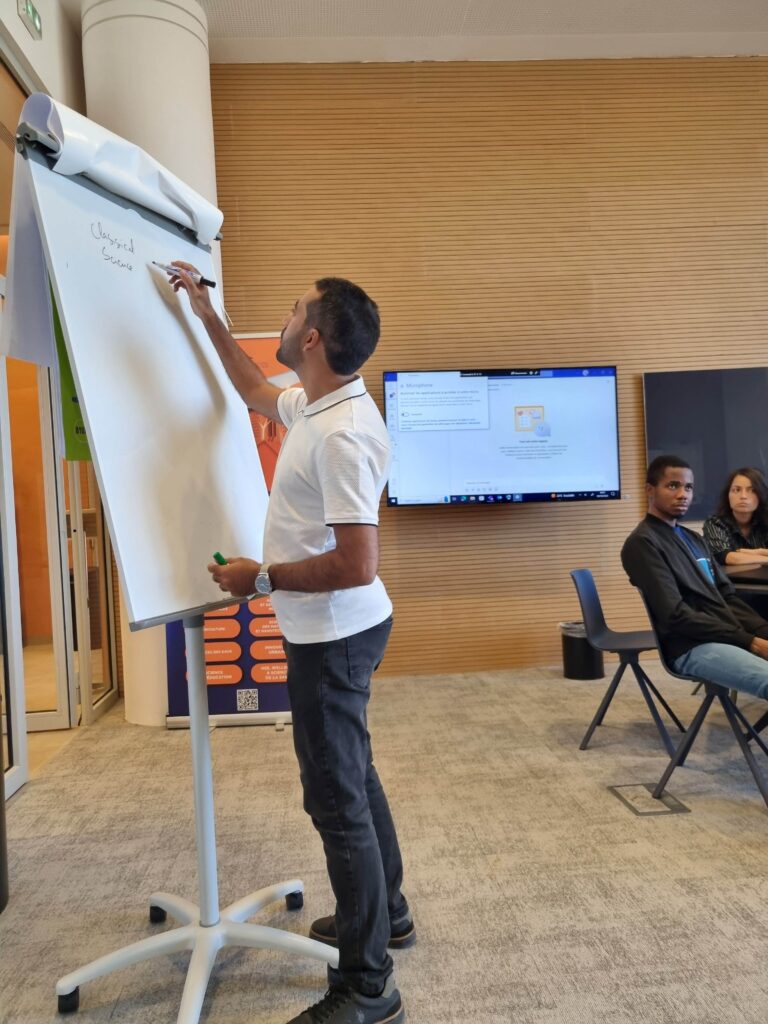 This biannual course for doctoral students is designed to explore the intricate nature of complex systems, focusing on the idea that the whole is more than the sum of its parts. Rooted in disciplines like mathematics, physics, and biology and spanning various fields, the course exposes students to non-linear sciences. It aims to equip participants to understand chaotic, unpredictable, and emergent dynamics that challenge traditional methods. By the end, students will have insights into chaos theory, fractal geometry, self-organization, and emergent properties, developing a new conceptual framework for their research. The course includes lectures, expert interactions, literature reviews, and online resources, encouraging students to apply these concepts to their research and understand the complexity of economic, social, cultural, technological, and natural environments. Topics include emergence, turbulence, swarm intelligence, and societal implications of complexity science.
Complexity Seminar, A Deep Dive into the Sciences of Complexity, ABS
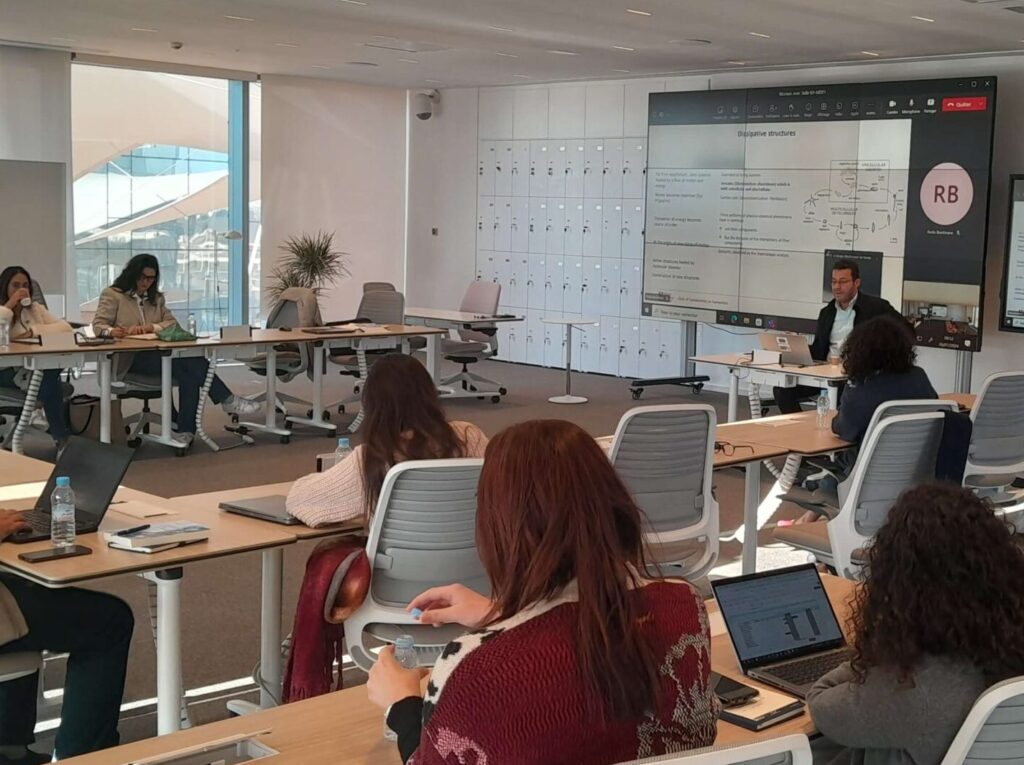
This Complexity Seminar is offered to high-profile managers and organized at Africa Business School. Participants are introduced to complexity science — the study of systems where the whole exceeds the sum of its parts — drawing on mathematics, physics, and biology, while extending into economic, social, cultural, and technological domains. The seminar covers core topics such as chaos theory, fractal geometry, self-organization, and emergent properties, offering participants a new conceptual lens for reading non-linear, unpredictable phenomena that resist classical analytical frameworks.
Change Mindset: Navigating Complexities and Humanities, SHBM
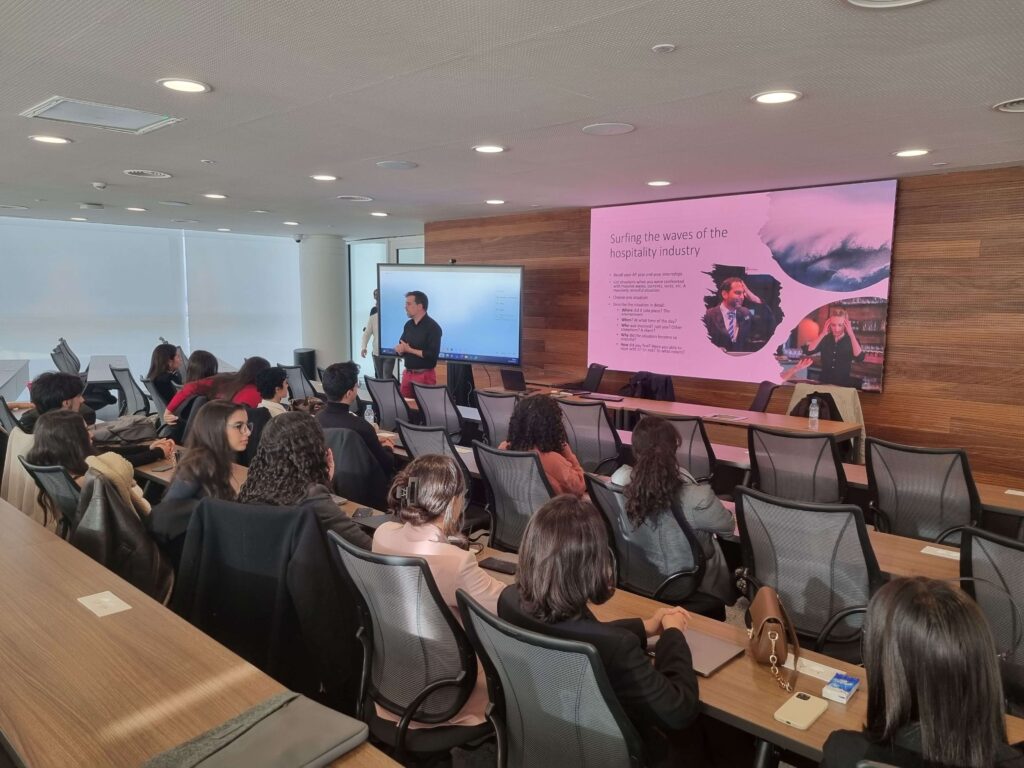 This is an introductory seminar on complexities and humanities that is adapted to the academic and professional settings of SHBM students. The seminar delves into complexity theory and its practical application in the context of various organizations. Students will gain a deep understanding of the principles of complexity, develop analytical skills to navigate complex situations, and learn how to apply complexity thinking to real-world challenges in various sectors.
Complexity Bootcamp, FGSES
Dans le cadre des Bootcamps organisés par le SCALES (Skills Cluster for Agile Learning in Economics & Social Sciences), la Chaire a organisé un bootcamp d’une journée consacré aux sciences de la complexité, ouvert aux étudiants de la FGSES. La session a proposé une introduction transdisciplinaire à la « grammaire » de la complexité, telle qu’elle se décline en mathématiques, en physique et en biologie, en explorant ses implications dans les environnements économiques, sociaux, culturels, technologiques et naturels.
Introduction to the Sciences of Complexity, DBA program ABS
This recurring course is offered to participants in Africa Business School’s DBA program. Designed to foster open, creative exchange among participants, with the core aim of having them share their own research and reflect on how a complexity-science approach could inform their work, culminating in short presentations built on their understanding and application of the course material. Content-wise, it combines lectures on core topics (introduction to complexity science, emergence and self-organization, turbulence, chaos, and randomness, non-Euclidean and fractal geometries, swarm intelligence and artificial intelligence, and complexity from science to society) with review of relevant literature and curated online video resources.
Altérités en/et devenir : Exploring Complexities and Humanities, Cultur.Ed
This hands-on seminar was organised for the participants of the Inspire program at Cultur.Ed. These young students, aged 18 to 30, spend a year acquiring and developing skills in cultural engineering through workshops, seminars, and field trips, producing their own understanding of each topic they explore. For this course, the Chair co-organised with the participants a session for the UM6P Science Week entitled Altérités en/et devenir. Students moderated the session, curated an art and photo exhibition, performed onstage, and more.